
Three Golden Rules to Improve Scooter Safety

Three Golden Rules to Improve Scooter Safety
By Mona Chiu

The SFMTA has some exciting news for all who use the sidewalk in the city! Starting May 1, 2023, we'll be launching a new safety campaign to promote safe and responsible electric scooter use for both permitted scooter share devices and privately operated scooters. The campaign will focus on three key safety rules that every rider should keep in mind while riding: no sidewalk riding, no speeding and no double riding (two people riding one device). By educating riders about the dangers of sidewalk riding, unsafe speeding and riding, and improper parking, we hope to make the city safer for everyone.    
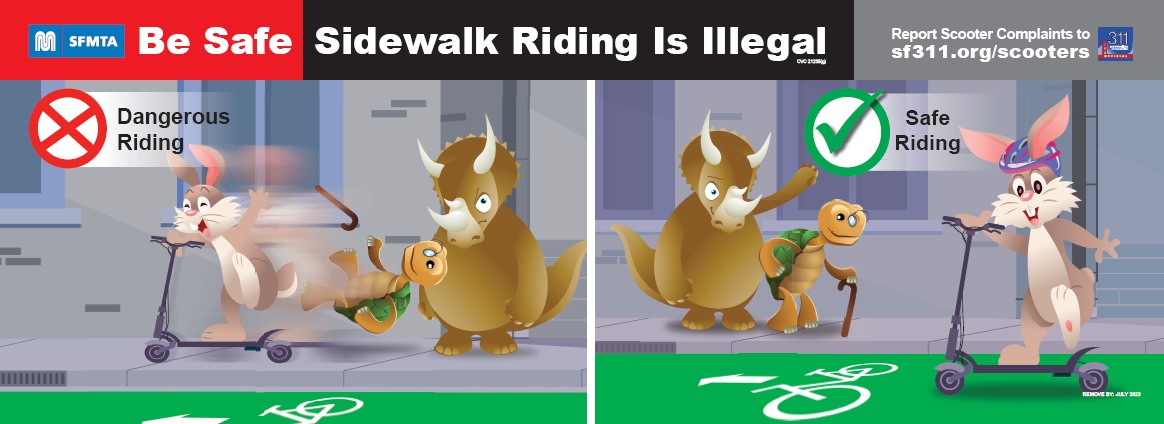
Animation images of cartoon animals riding a scooter. There are two images side by side. The left image shows a rabbit riding a scooter on the sidewalk with a turtle falling and a rhinoceros standing. The right image shows the same rabbit on a stationery scooter with the turtle and rhinoceros standing and smiling.

Sidewalk riding has been a major concern for pedestrians in San Francisco, and it's illegal to ride an electric scooter on the sidewalk.   
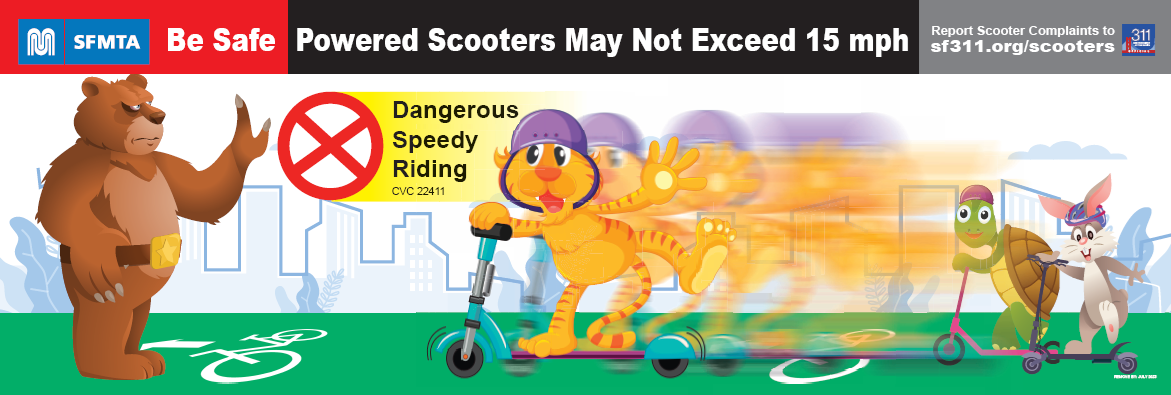
Animated image of a cat, turtle and rabbit on a scooter with a bear holding up their hand attempting to the stop the riders.

 Electric scooters can travel at speeds of up to 15 miles per hour, which can be dangerous if riders aren't paying attention to their surroundings. The SFMTA's safety campaign will encourage riders to be mindful of their speed (riding over 15 miles per hour is illegal) and to obey traffic laws. 

The campaign will also focus on emphasizing double riding is illegal. By law, only one rider should ride a scooter at a time.  

Animated image of a rabbit on the scooter with a bottle. They are confused and distraught.

To spread the word about this safety campaign, we will be placing posters on Muni buses, displaying ads in Muni bus stops and running ads on social media. This should help us reach as many scooter riders as possible and encourage them to prioritize safety while riding. 
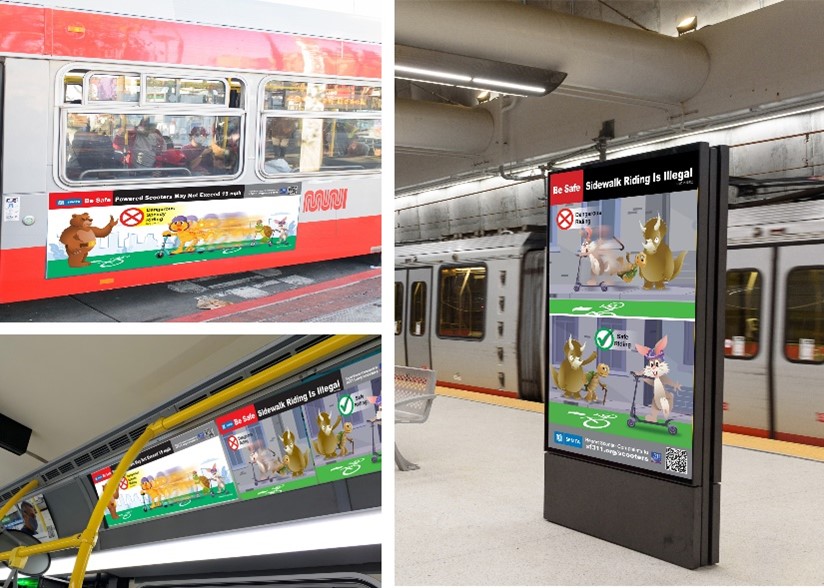
Three images showing the side of a bus, a station platform sign and a close up of a car car inside a bus.

The SFMTA already has been actively working to improve scooter safety in San Francisco. We have implemented several policies and regulations, including: 

  • Requiring permitted scooter companies to provide a lock-to system to keep parked scooters out of the accessible path of travel  
  • Requiring permitted scooter companies to develop and implement a plan for safe riding. These plans include rider training, in-app messages with safety messages and sidewalk detection technology on their devices.  
  • Encouraging scooter permittees to adopt an escalating penalty structure for improper riding and parking 
  • Working with the Port of San Francisco to reduce sidewalk riding on the Embarcadero.  

The agency has also worked to improve infrastructure for scooter riders. We have installed: 

  • 3,000+ racks installed since the beginning of scooter permit program in 2018 
  • 11,000+ bike racks available citywide for scooter parking  
  • 465 miles of bikeways in San Francisco 
  • 78 miles off-street paths 
  • 139 miles of bike lanes (Class II) 
  • 43 miles of separated bikeways (Class IV)  
  • 45 miles of bike lanes and separated bikeways added since 2018 
  • 33 miles of Slow Streets 

The agency is also working to expand the active transportation network in the city through our new Active Communities Plan. 

If you want to report any complaints related to scooter riding, you can call 311 or visit the 311 website.  

To learn more about what the SFMTA is doing to promote a safe and useful scooter share system, visit our scooter share permit project page and view our data dashboards. 


Published May 01, 2023 at 10:02PM
https://ift.tt/cNWsO2e

Comments

Popular posts from this blog

Slow Streets Program to Help With Social Distancing

Slow Streets Program to Help With Social Distancing By With Muni service temporarily reduced during the COVID-19 health crisis, many San Francisco residents need to walk and take other modes of transportation to make essential trips. However, sometimes it is difficult to maintain 6’ of social distance on many sidewalks, park paths, and bikeways. This can be especially true when passing lines outside grocery stores and other essential services. Because of this, many pedestrians are choosing to walk in the street, exposing themselves to swiftly moving vehicle traffic. The SFMTA is implementing a new program, Slow Streets, to close some streets to through traffic and allow roadways to be used more as a shared space for foot and bicycle traffic. Throughout the city, corridors have been identified for Phase 1 Slow Streets. Beginning this week, some of these streets will be closed to through vehicle traffic to prioritize walking/biking and to provide more space for social distancing duri...

Weight Loss Success Stories: 6 People Share How They Shed Pounds with a High-Protein Diet

Weight Loss Success Stories: 6 People Share How They Shed Pounds with a High-Protein Diet Sarah:  Sarah, a 32-year-old mother of two, struggled with her weight after having her second child. She decided to try a high-protein diet and was able to lose 30 pounds in just three months. She replaced her breakfast with a protein shake, ate a salad with grilled chicken for lunch, and had fish or chicken with vegetables for dinner. Mike:  Mike, a 45-year-old man, had been overweight his entire life. He tried various diets, but none of them worked for him. He decided to give a high-protein diet a try and was able to lose 50 pounds in six months. He ate eggs, chicken, fish, and lean meats for most of his meals and limited his intake of carbohydrates and sugary foods. Emily:  Emily, a 28-year-old woman, had been struggling with her weight since her teenage years. She tried many diets and weight loss programs, but nothing seemed to work for her. She decided to try a high-p...

Celebrating the life and legacy of Harvey Milk

Celebrating the life and legacy of Harvey Milk By Sophia Scherr Today we celebrate and remember the life of San Francisco LGBTQ+ advocate and icon, Harvey Milk. One of our city’s most revered politicians, Milk's legacy as the first openly gay San Francisco supervisor and elected official in California helped in breaking down discriminatory barriers and usher LGBTQ+ politicians in government positions. Milk also advocated for equitable transportation, as he rode Muni exclusively since he did not own a car. He was a firm believer that affordable mobility was important in creating a thriving and livable city. Below is Harvey Milk with Curtis E. Green, General Manager of the Municipal Railway promoting Muni’s “Fast Pass”. Mr. Green was a barrier-breaking figure in his own right, by becoming the first African American appointed to Muni's top position from his beginnings with the Agency as a bus operator. With his 1974 appointment, Green also became the first African American to ...