By Anne Yalon
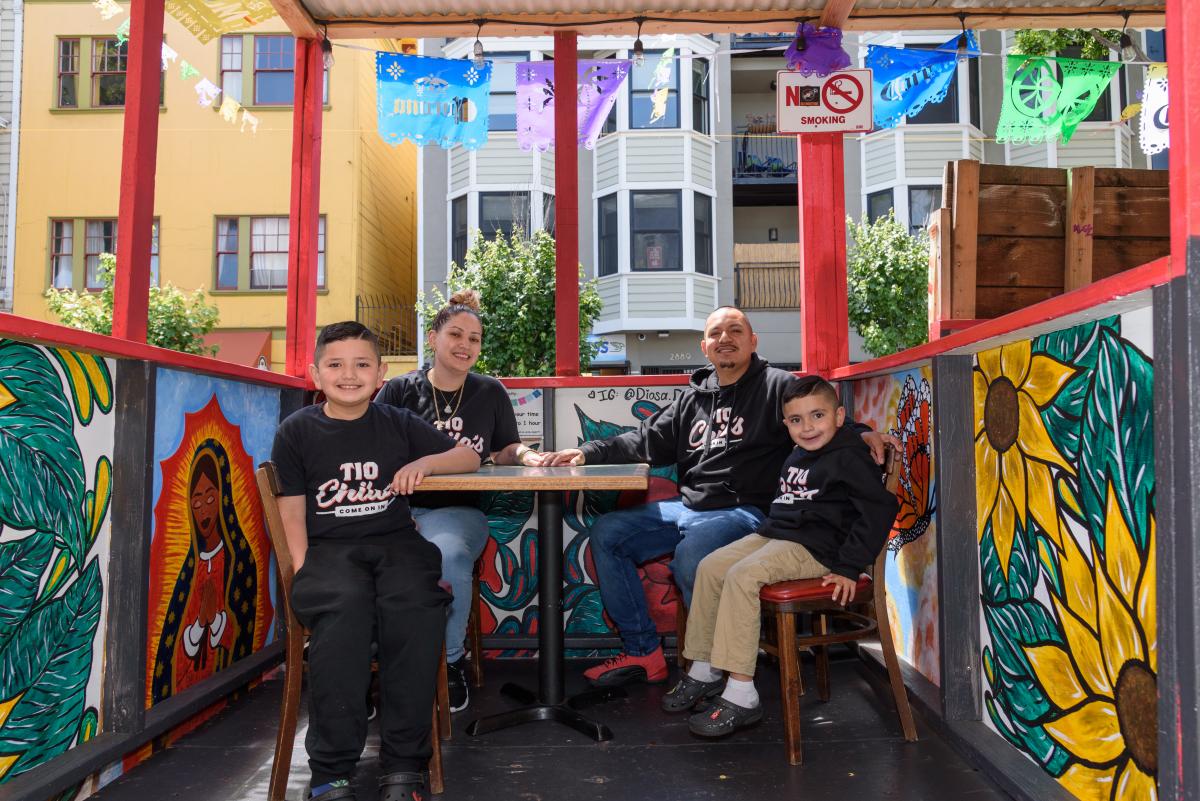
Shared Spaces, amongst many other benefits, allows our residents and families to enjoy safe and social outdoor dining. Seen here are the the owners of Tio Chilo’s Grill and their children in the restaurant’s parklet on 24th Street in the Mission.
San Francisco’s popular Shared Spaces program allows merchants, restaurants and arts and culture organizations to use the curbside, sidewalk and other public spaces to conduct local business activities and stay afloat. What emerged as an economic lifeline during the pandemic is making San Francisco’s streets more energized, engaged and activated.
Many of the Shared Spaces parklets have become central gathering places for the local community. “Our parklet makes me feel like when I go to Mexico, where outdoor seating is everywhere. People end up joining their friends in our parklet. It is a space for our customers and our community," said Liz Vazquez, owner of Tio Chilos Grill. Ray Bair, owner of Cheese Plus, said, "My Shared Space has been a community gathering space. It's an ideal location because we are on a corner. I go out to it every afternoon and see so many people from the neighborhood sitting and enjoying the space. It's so satisfying to see people using the space for what the Shared Spaces program was intended for."
Now, Shared Spaces is transitioning from an emergency initiative to a permanent program. In July 2021, the San Francisco Board of Supervisors unanimously passed legislation introduced by Mayor London Breed to make the Shared Spaces Program permanent. Permits from the pandemic-era Shared Spaces Program were extended to June 30, 2022 and then later to March 31, 2023. Parklet owners have until January 15, 2023 to renew their permits which, once approved, will go into effect on April 1, 2023.
The extension has allowed additional time for small businesses to make any necessary modifications to their shared spaces as they transition into a longer-term permit. Because many of the Shared Spaces were built very quickly, some of them need to be modified to meet the most up-to-date guidelines for safety and accessibility.
So far, 450 permit applications have been submitted for the long-term Shared Spaces program. San Francisco operators who want to keep their existing outdoor Shared Space beyond March 2023 need to renew their permits by January15, 2023. Permit holders wishing to end their existing Shared Space also need to notify Shared Spaces.
Parklet owners who are still deciding if a Shared Spaces permit will work for their business or need to modify their Shared Space to fit the city’s design guidelines can watch the 2-minute design guidelines videos. These videos explain how to make Shared Space safe and accessible for all. They focus on intersection safety and visibility, and emergency access for the fire department. Another video about disability access is in the works.
More information for parklet owners is available at these upcoming events:
Application and site plan workshop
When: Tuesday, Dec. 13, 2 p.m.-3:30 p.m
Where: The Crossing, 200 Folsom St. San Francisco. Register here.
Who: Current parklet operators wishing to apply for a permit.
This interactive, in-person training will ensure that parklet operators and professionals designing and building parklets understand how to create a site plan and an application. Have a question? Bring your application and site plan with you and have our team of experts review it and provide feedback. Please RSVP and submit your questions in advance here. The training will be 1 hour and 30 minutes in length, including a 45-minute Q & A.
Parklet Design Training
When: Thursday, Dec. 15, 9:30 a.m-11 a.m.
Where: 49 South Van Ness, Room 136.egister here
Who: Designers, builders and contractors of parklets.
This interactive, in-person training will ensure that professionals designing and building parklets understand design requirements and best practices for safety and accessibility at Shared Spaces parklets. Attendees will receive a certificate of attendance and will be listed on the program website as having attended the City’s training. Please RSVP and submit your questions in advance here. The training will be 1 hour and 30 minutes in length, including a 30-minute Q & A.
Roadway Closure application and site plan workshop
When: January (check the Shared Spaces website for updates)
More information is available on the Shared Spaces website. To see photos of parklets and featured parklet owners, check out Shared Spaces on Instagram and Twitter.
The SFMTA is proud to help operate the program in partnership with the Mayor’s Office, Department of Planning, Department of Public Works, Digital Services, Entertainment Commission, Office of Economic and Workforce Development, Mayor’s Office on Disability, 311, Department of Technology, Public Utilities Commission and Fire Department.
Published December 09, 2022 at 01:36AM
https://ift.tt/eiysNr6
Comments
Post a Comment
If you have any doubt's, please let me know