By Mariana Maguire
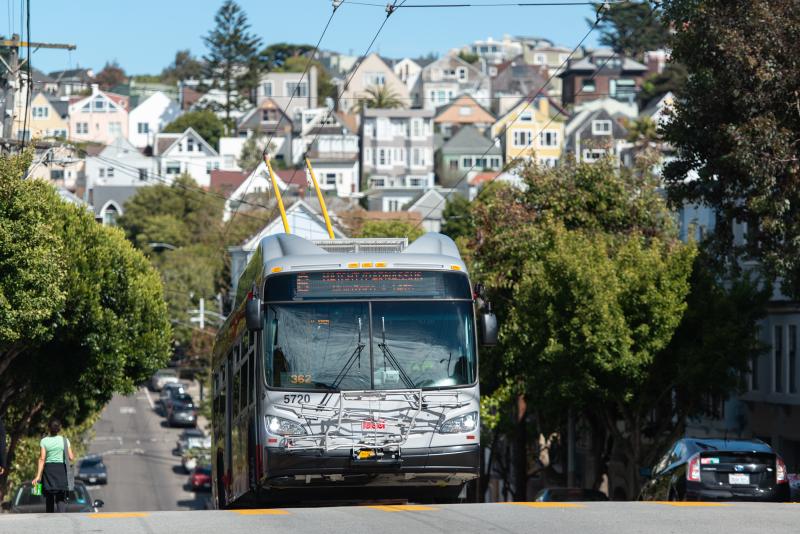
Photo caption: The 6 Haight-Parnassus is one of the Muni bus routes that will be brought back into service July 9, 2022 after being temporarily suspended since March 2020.
On July 9, the next phase of the 2022 Muni Service Network plan will go into effect, focused on expanding bus service including the return of the 2 Sutter, 6 Haight-Parnassus and 21 Hayes (with some route changes), as well as other route extensions and modifications.
Public feedback helped us prioritize bringing back routes and connections many communities rely on. Read more about what we heard from the public and how we incorporated feedback into the 2022 service proposal.
As resources allow, our service changes will continue prioritizing service linking neighborhoods identified by our Muni Service Equity Strategy to essential destinations like hospitals and neighborhood commercial corridors, accommodate changing travel patterns and getting the most of our system. We heard from many seniors and people with disabilities that bringing back the connection to the Jewish Community Center food hub is an important priority, so we are bringing back the 2 Sutter between Presidio Avenue and California Street and the Ferry Plaza at Embarcadero. For service west of Presidio Avenue, customers can take the 1 California, which runs more frequently one block north of Clement Street.
Restored Routes
|
Route |
Details |
Frequency |
|---|---|---|
|
2 Sutter |
Restore pre-pandemic route between the Ferry Plaza and Presidio Avenue at California Street, restoring connections to the Jewish Community Center food hub. |
Every 20 minutes |
|
6 Haight-Parnassus |
Restore pre-pandemic connections in response to community feedback. |
Every 20 minutes |
|
21 Hayes |
Restore modified pre-pandemic route from St. Mary’s Hospital to Grove and Hyde streets, by Civic Center Station and the Main Library. |
Every 20 minutes |
Modified Routes
|
Route |
Details |
Frequency |
|---|---|---|
|
23 Monterey |
Extend to pre-pandemic route along Sloat Boulevard to the San Francisco Zoo and Great Highway in response to community feedback. |
Weekdays every 20 minutes Weekends every 30 minutes |
|
28 19th Avenue |
Extend east of Van Ness Avenue at North Point Street to run between Daly City BART and Powell at Beach streets, providing connections to Fisherman’s Wharf to customers on the westside of the city and who are no longer covered by the 49 Van Ness-Mission. |
Weekdays every 12 minutes Weekends every 15 minutes |
|
43 Masonic |
Extend north of Presidio Avenue at California Street to the Presidio, the Marina and Fort Mason on its pre-pandemic route between Fort Mason and Munich Street at Geneva Avenue in response to community feedback. |
Weekdays every 12 minutes Weekends every 20 minutes |
|
49 Van Ness-Mission |
Shorten to its previous route between City College and Van Ness Avenue at North Point Street. |
Weekdays every 6 minutes Weekends every 8 minutes |
|
57 Parkmerced |
Extend from Eucalyptus Drive and Junipero Serra Boulevard to West Portal Station, restoring the connection to West Portal. |
Every 20 minutes
|
|
58 Lake Merced |
Modify to run along Lake Merced Boulevard instead of Sloat Boulevard and Brotherhood Way instead of John Daly Boulevard, from Mission Street and Daly City BART to Stonestown. |
Every 30 minutes |
|
66 Quintara |
Return to pre-pandemic alignment terminating in the Inner Sunset. |
Every 20 minutes |
|
L Bus |
Shorten route to run between the SF Zoo and West Portal Station and increase frequency in response to changing trip patterns. |
Weekdays every 8 minutes Weekends every 10 minutes |
Looking Ahead
We plan to continue implementing the approved 2022 Muni Service Network in additional phases as we bring more operators onboard. Read more about the complete 2022 Muni Service Network plan.
Published June 25, 2022 at 12:34AM
https://ift.tt/5HDUFrw
Comments
Post a Comment
If you have any doubt's, please let me know