
This Day in History: McAllister Street 1909

This Day in History: McAllister Street 1909
By Jeremy Menzies

Here’s a look back to April 29,1909 with two photos showing an important change to McAllister Street in the Western Addition. McAllister has been served by a transit line since at least the 1880s. Beginning with a cable car run by the Market Street Cable Railway, McAllister served as an important part of the city’s east-west transit system. 

These two photos show construction work to remove the old cable car tracks and replace them with electric streetcar rails:
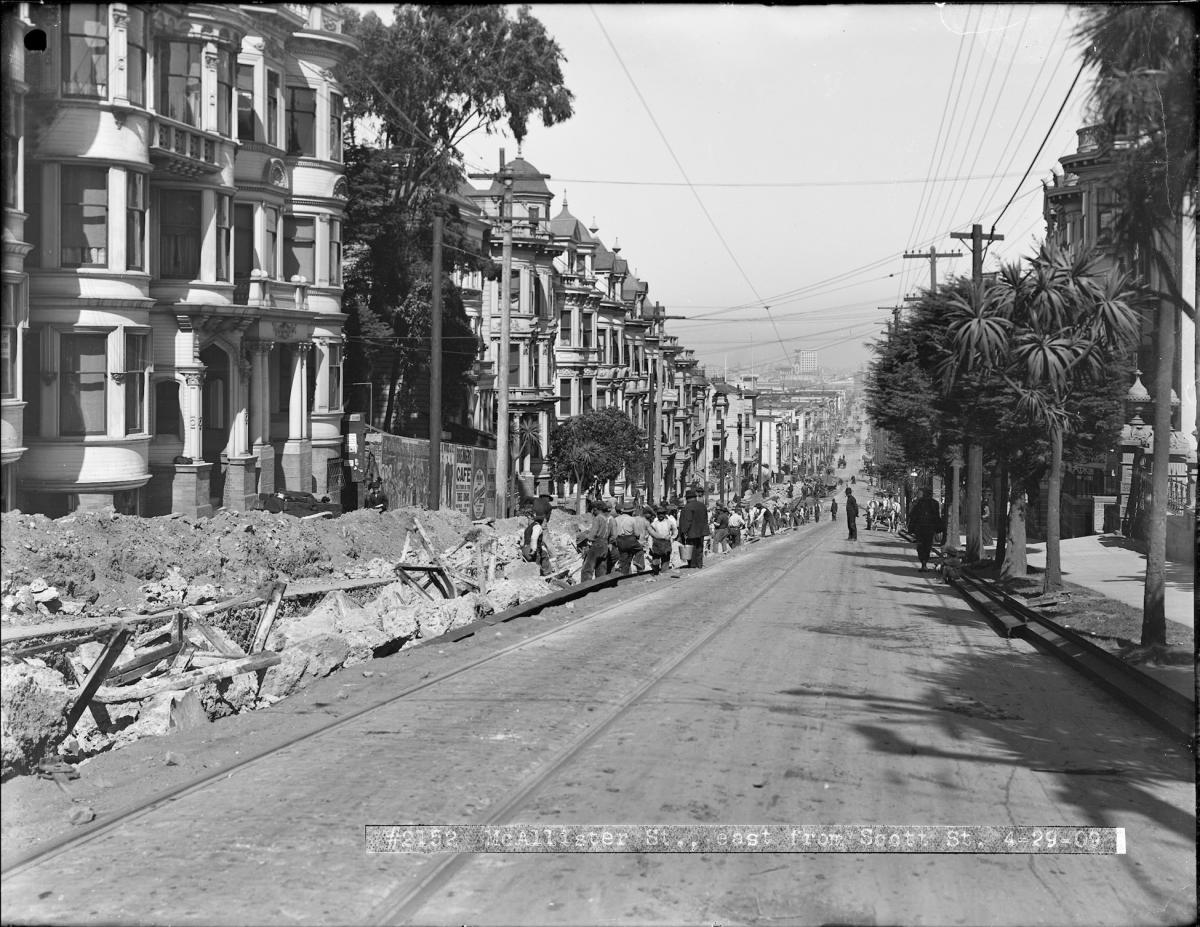
Laborers dig cable car “yokes” out of the street on McAllister between Scott and Pierce streets. Yokes are heavy steel frames that support both the rails and the cable channel on a cable car trackway.

Laborers dig cable car “yokes” out of the street on McAllister between Scott and Pierce streets. Yokes are heavy steel frames that support both the rails and the cable channel on a cable car trackway.

Prior to the 1906 Earthquake and Fires, San Francisco’s transit system was largely made up of cable car lines, which made navigating the steep hills easy. However, the cable cars were slow and costly to operate compared to newer electric streetcars.  Following the ‘06 disaster, in an effort to rebuild and modernize the system, nearly all cable car lines were replaced by electric streetcar lines.  
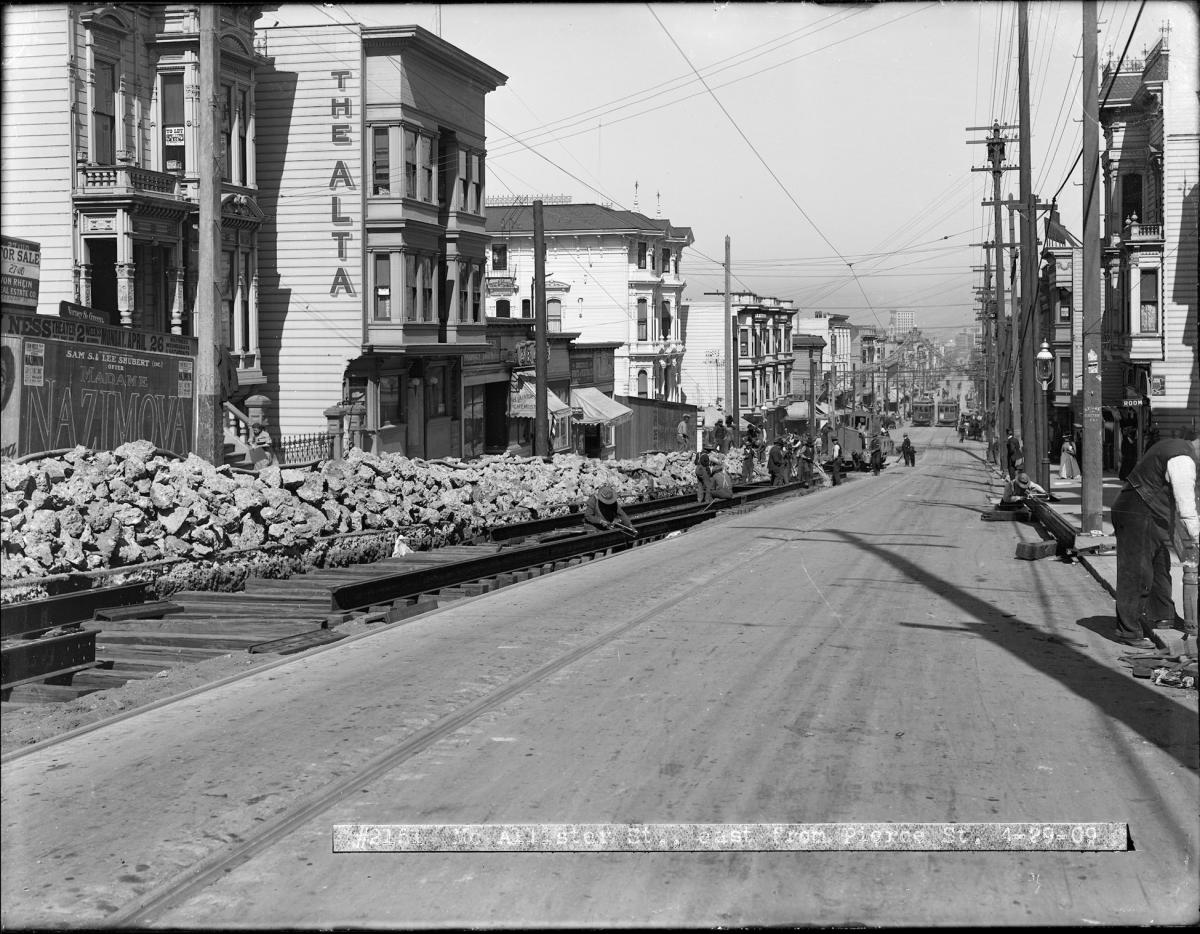
Workers install ties and rails to run the 5 McAllister Streetcar Line on McAllister and Pierce.

Workers install ties and rails to run the 5 McAllister Streetcar Line on McAllister and Pierce. 

As can be seen in the photos, the work to replace the cable tracks was labor intensive and difficult. Due to the way cable car lines were built, the work to remove them had to be done almost entirely by hand with picks, prybars, and shovels. Laying streetcar tracks was marginally easier with the help of special work streetcars. All the work to lay and align the new tracks was done by hand. 

Today, the 5 and 5R routes carry on the legacy of these cable and streetcar predecessors by continuing to serve this same stretch of McAllister.


Published April 30, 2022 at 02:41AM
https://ift.tt/RVq19KC

Comments

Popular posts from this blog

Celebrating the life and legacy of Harvey Milk

Celebrating the life and legacy of Harvey Milk By Sophia Scherr Today we celebrate and remember the life of San Francisco LGBTQ+ advocate and icon, Harvey Milk. One of our city’s most revered politicians, Milk's legacy as the first openly gay San Francisco supervisor and elected official in California helped in breaking down discriminatory barriers and usher LGBTQ+ politicians in government positions. Milk also advocated for equitable transportation, as he rode Muni exclusively since he did not own a car. He was a firm believer that affordable mobility was important in creating a thriving and livable city. Below is Harvey Milk with Curtis E. Green, General Manager of the Municipal Railway promoting Muni’s “Fast Pass”. Mr. Green was a barrier-breaking figure in his own right, by becoming the first African American appointed to Muni's top position from his beginnings with the Agency as a bus operator. With his 1974 appointment, Green also became the first African American to ...

Introducing My Shocks. 😉 Ciggerate Whatsapp Status (SAD BOYS)#short #shorts #cigarette

via https://youtu.be/RpDENmVEg7M

By The Numbers: The SFMTA’s COVID-19 Response

By The Numbers: The SFMTA’s COVID-19 Response By Erica Kato The COVID-19 pandemic has brought about unforeseen c hanges to San Francisco’s transportation network. And the impact of the crisis will continue to be felt city-wide long beyond the end of the public health emergency. On March 13, 2020, when it became clear that San Francisco needed immediate adjustments to the transportation system, Director of Transportation Jeff Tumlin launched SFMTA’s Department Operations Center (DOC) team. Since then, the DOC has served as a centralized hub to ensure that we are minimizing health risks to employees and the public as we keep transportation running, both by coordinating internally within the agency and by collaborating closely with our city, state, and federal partners to deploy resources and information in the most effective way possible. San Francisco's response to the COVID-19 pandemic included implementing temporary emergency transit lanes  Our COVID-19 response has chal...