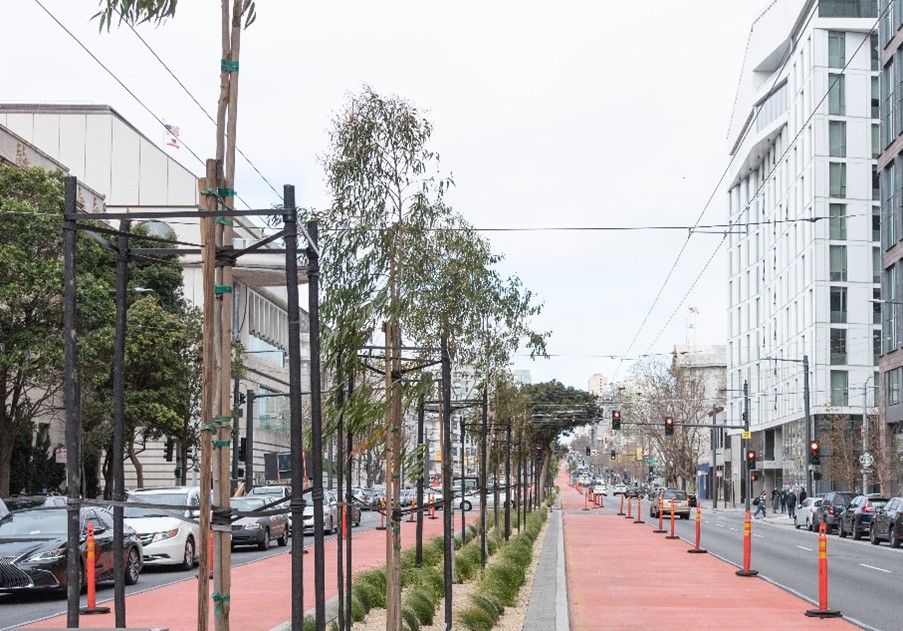
The Van Ness BRT Will Soon Welcome You

The Van Ness BRT Will Soon Welcome You
By John Gravener

New Van Ness Avenue transit lanes open to Muni and Golden Gate Transit buses April 1, 2022.

We will be celebrating the new Van Ness Bus Rapid Transit system with a ribbon-cutting ceremony at the War Memorial on April 1, at 9:15 a.m., and you are invited!

This immense civic improvement project has not only brought the first Bus Rapid Transit corridor to San Francisco, it also presented the opportunity to do much-needed underground and utilities work. This project looks towards San Francisco’s future with an eye towards climate resiliency and transit efficiency

The Bus Rapid Transit corridor provides a globally proven solution to improve transit service and address traffic congestion on Van Ness Avenue. With the new, physically-separated transit lanes along the Van Ness corridor, buses will be able to travel without getting caught up in traffic and passengers will be able to board buses more easily. Other benefits include improved lighting, sidewalk extensions (bulb-outs), new countdown signals for people crossing Van Ness and improved accessibility for those with mobility needs.

As great as the street-level improvements are for Van Ness Avenue, the work that has been completed underground is just as important. The construction that has been completed allowed for extensive utility maintenance which included the replacement of sewer pipes and water mains, some that had not been replaced in more than 100 years! This work prepares San Francisco for the next major earthquake and the effects of climate change with stronger infrastructure. The emergency water supply system dating back to the early 1900s was also part of the overhaul, providing firefighters adequate water pressure and volume throughout the city to fight fires, a hard-learned lesson from the 1906 earthquake and fires: Fires ripped through the city after the 1906 earthquake because the water mains had been severely damaged and there was no water pressure. The emergency water supply system was implemented soon after to prevent history from repeating itself.

We look forward to seeing you on Van Ness. We appreciate your patience as we revitalize the historic corridor. We hope you’ll enjoy it.

For details about the ribbon-cutting and to RSVP, go to SFMTA.com/VanNess.


Published March 18, 2022 at 09:19PM
https://ift.tt/4zEQxZP

Comments

Popular posts from this blog

Celebrating the life and legacy of Harvey Milk

Celebrating the life and legacy of Harvey Milk By Sophia Scherr Today we celebrate and remember the life of San Francisco LGBTQ+ advocate and icon, Harvey Milk. One of our city’s most revered politicians, Milk's legacy as the first openly gay San Francisco supervisor and elected official in California helped in breaking down discriminatory barriers and usher LGBTQ+ politicians in government positions. Milk also advocated for equitable transportation, as he rode Muni exclusively since he did not own a car. He was a firm believer that affordable mobility was important in creating a thriving and livable city. Below is Harvey Milk with Curtis E. Green, General Manager of the Municipal Railway promoting Muni’s “Fast Pass”. Mr. Green was a barrier-breaking figure in his own right, by becoming the first African American appointed to Muni's top position from his beginnings with the Agency as a bus operator. With his 1974 appointment, Green also became the first African American to ...

By The Numbers: The SFMTA’s COVID-19 Response

By The Numbers: The SFMTA’s COVID-19 Response By Erica Kato The COVID-19 pandemic has brought about unforeseen c hanges to San Francisco’s transportation network. And the impact of the crisis will continue to be felt city-wide long beyond the end of the public health emergency. On March 13, 2020, when it became clear that San Francisco needed immediate adjustments to the transportation system, Director of Transportation Jeff Tumlin launched SFMTA’s Department Operations Center (DOC) team. Since then, the DOC has served as a centralized hub to ensure that we are minimizing health risks to employees and the public as we keep transportation running, both by coordinating internally within the agency and by collaborating closely with our city, state, and federal partners to deploy resources and information in the most effective way possible. San Francisco's response to the COVID-19 pandemic included implementing temporary emergency transit lanes  Our COVID-19 response has chal...

Slow Streets Program to Help With Social Distancing

Slow Streets Program to Help With Social Distancing By With Muni service temporarily reduced during the COVID-19 health crisis, many San Francisco residents need to walk and take other modes of transportation to make essential trips. However, sometimes it is difficult to maintain 6’ of social distance on many sidewalks, park paths, and bikeways. This can be especially true when passing lines outside grocery stores and other essential services. Because of this, many pedestrians are choosing to walk in the street, exposing themselves to swiftly moving vehicle traffic. The SFMTA is implementing a new program, Slow Streets, to close some streets to through traffic and allow roadways to be used more as a shared space for foot and bicycle traffic. Throughout the city, corridors have been identified for Phase 1 Slow Streets. Beginning this week, some of these streets will be closed to through vehicle traffic to prioritize walking/biking and to provide more space for social distancing duri...