By Jeremy Menzies
The first San Francisco Municipal Railway streetcars rolled into service 109 years ago on December 28, 1912. Muni was not the first transit provider in the city, nor the first publicly run railway in the country. However, it was the first to be established in a major US city, giving it widespread recognition. Muni’s immediate success set an example that many cities across the country would come to follow.
Reflecting on this recently passed anniversary, we took a look at some of the key events that led to the creation of Muni. What we found was a unique political, economic and social climate in San Francisco around the turn of the 20th century, all leading to the establishment of “the people’s railway”..
Monopolies Control Transit
In the late 1800s, San Francisco’s transportation system wasn’t fit for the needs of the booming city. Service was provided by more than a dozen separate companies using a mix of modes ranging from steam trains to electric streetcars. Competition between companies created a confusing network for riders with duplicative lines mostly serving downtown, each with their own fare policies.
By 1902, multiple mergers of smaller companies led to nearly all lines being run by the United Railroads of San Francisco. Unfortunately for San Franciscans, URR’s main priority was making profits for its investors and executives, not providing the best transit service. With a near monopoly on all public transit, there was little the public could do to demand better service.
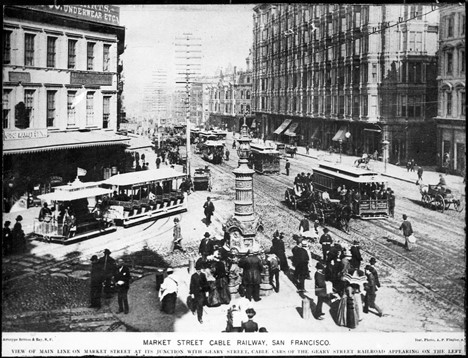
This is what public transit in San Francisco looked like in the 1890s and early 1900s. A complicated system of lines run by over two dozen different companies, dominated by cable cars.
The Push for Public Ownership
Around the turn of the 20th century, cities across the country were experiencing rapid economic and population growth as people flocked in to fill new industrial, service, and construction jobs. Life in the city exposed the deep economic differences between rich and poor. In San Francisco, a small wealthy class controlled most of the city’s industry and utilities like water, power, and transportation. Living the high life while many of those they employed struggled to get by working 12-hour days for low wages.
The city government was seen as a tool to help equalize these disparities and popular support for the city to take control over basic utilities that everyone needed. In this political climate, a new charter was passed in 1900 which charged City Hall with gradually taking ownership of all essential public services. This charter laid the groundwork for building Muni, as well as other services that would come later, like the Hetch Hetchy Water and Power System and SFO airport.
Disaster Exposes Deep Corruption
The 1906 Earthquake and Fire destroyed most of the city and left vital transportation services in shambles. Shortly after the disaster, deals were made to allow URR to convert nearly all its cable, horse car, and steam lines to modern electric streetcar operation. The company’s heavy investment in reconstruction efforts improved the system and helped get the city back on its feet.
In the years following the quake, positive public impressions of URR were quickly ruined by the discovery of bribery between company officials and City Hall. By 1910, the board of supervisors, mayor and all corrupt city officials were removed from office in attempt to clear the slate.
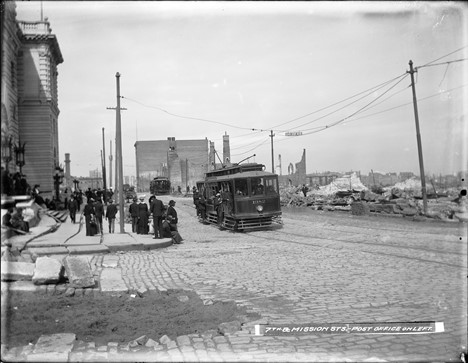
Transit service following the 1906 disaster was critical in getting the city running again. Here an electric streetcar packed with people on Mission & 7th streets passes by another essential service, the US Post Office.
Labor Unrest
URR’s corrupt practices and focus on profits also created serious problems for the company’s workforce. In 1902 and 1907, streetcar employees went on strike to demand better working conditions. The 1907 strike lasted months, with URR hiring armed strikebreakers to battle with strikers, turning into one of the deadliest in San Francisco history. All told, more than 25 people died and 1,100 were injured from clashes and accidents.
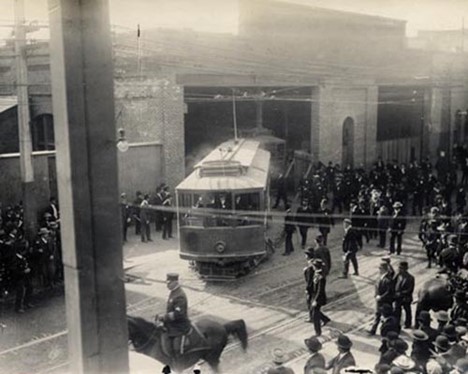
This 1907 shot shows a streetcar on Turk and Fillmore Streets under police protection during the deadly URR strike. (Image courtesy CA State Library: Dobbin, Hamilton Henry. Streetcar Strike. N.p., 1907. Print.)
The Municipal Railway Dream Realized
After three attempts to pass bond measures to build a city-owned railway between 1902 and June 1909, a fourth ultimately succeeded in December 1909. With over $2 million in bond money, San Francisco finally had a transit system “for the people, by the people” within sight.
Construction began in June 1911 on the A and B Geary streetcar lines, which would serve Golden Gate Park and the ocean from Market and Kearny streets. By the end of 1912, the city had its own electric railway line with modern streetcars, a brand-new headquarters, and a promising future ahead.
As the city’s first publicly owned utility, the opening of Muni was a source of great civic pride. On the first day of service, a reported 15,000 people rode the streetcars and more than 50,000 gathered downtown to see the dream that was years in the making.
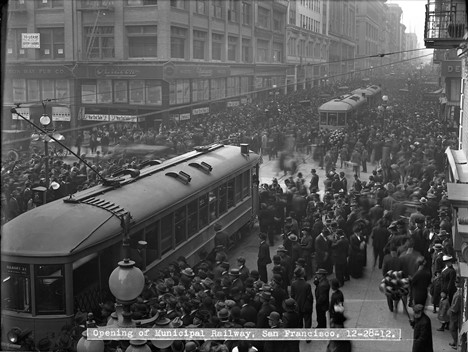
Opening day of the San Francisco Municipal Railway on December 28, 1912. Muni was the first publicly owned railway line in a major American city, sparking a national movement.
Today, Muni is one of the nation’s largest transit systems. Our special blend of historic and modern vehicles, rail lines and bus routes, and administrative structure reflect our city’s history and our citizen’s values. Created in a political and economic climate as unique as San Francisco itself, Muni stands as an enduring symbol of what can be done in the “City that Knows How”.
Published February 01, 2022 at 01:13AM
https://ift.tt/C5JvO0xTL
Comments
Post a Comment
If you have any doubt's, please let me know