San Francisco Announces Bold Commitment to Safer Streets

San Francisco Announces Bold Commitment to Safer Streets
By Ryan Reeves

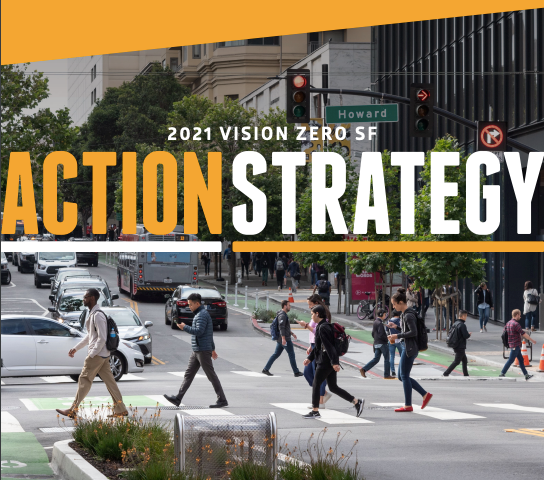
Photograph of pedestrians crossing Howard Street; protected bike lanes in the foreground and background. “2021 Vision Zero SF Action Strategy” is overlaid on the image.

This week, San Francisco Mayor London Breed released  the 2021 Vision Zero Action Strategy—our City’s multi-agency framework for eliminating traffic deaths and reducing severe injuries.

The City and County of San Francisco committed to ending traffic fatalities through Vision Zero in 2014. Since then, our approach has continued to evolve – we've incorporated new strategies and expanded on existing and successful programs. In this updated plan, we commit to bold and ambitious strategies to create safer streets. We will double down on redesigns to make streets safer for people, and expand programs like our Vision Zero Quick-Build across the city’s High Injury Network (HIN), the 13% of city streets that account for more than 75% of severe and fatal injuries.

The Vision Zero Action Strategy lays out a clear path for the city towards this ambitious goal over the next three years. The strategy focuses on slowing speeds and safer crossings. More than 80 miles of our city’s High Injury Network have been upgraded or are in construction with core safety improvements. This strategy commits the City to expand the successful Quick-Build initiative to cover the remaining 80 miles in the High-Injury Network. As part of this effort, we are committed to adding daylighting and high-visibility crosswalks to every intersection along the HIN. We will also update all eligible signals to give pedestrians head-starts and more time for crossing the street. The strategy also commits us to updating our City’s Active Transportation Network, connecting car-light/car-free streets to protected bike lanes by 2024. Through these design changes, we can make walking, biking, and taking transit safer and more accessible for San Franciscans.
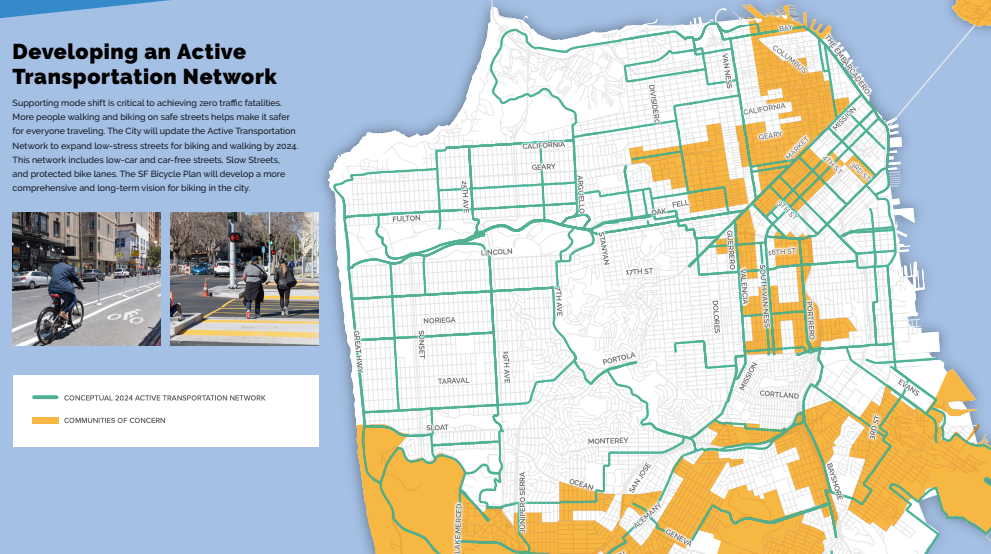
A page from the Vision Zero Action Strategy describing San Francisco’s plan to establish an active transportation network. Supporting mode shift is critical to achieving zero traffic fatalities. More people walking and biking on safe streets helps make it safer for everyone traveling. The City will update the Active Transportation Network to expand low-stress streets for biking and walking by 2024. This network includes low-car and car-free streets, Slow Streets, and protected bike lanes. The SF Bicycle Plan will develop a more comprehensive and long-term vision for biking in the city. The map shows a conceptual 2024 Active Transportation Network that covers the whole city, including the Great Highway to the west, Alemany and Lake Merced Boulevard to the south, JFK Drive through Golden Gate Park, Arguello Boulevard into the Presidio, the Embarcadero, and Market Street.

This strategy shows how policy change can make a significant impact in expanding our tools for safer streets. Under the recently passed AB43, which gives cities the authority to lower speed limits along certain corridors, San Francisco will begin implementing 20 mph zones along key streets as early as next year. We will also develop and implement a comprehensive speed management plan, including education and outreach to advance a culture of traffic safety. Lowering speeds by even 5 mph can make a significant difference for safety: We have seen from peer cities like Seattle that implementing 20 mph zones can decrease collisions by around 20%. We will also continue to push for policies like congestion pricing that incentivize mode shifts away from driving and toward active transportation and public transit.
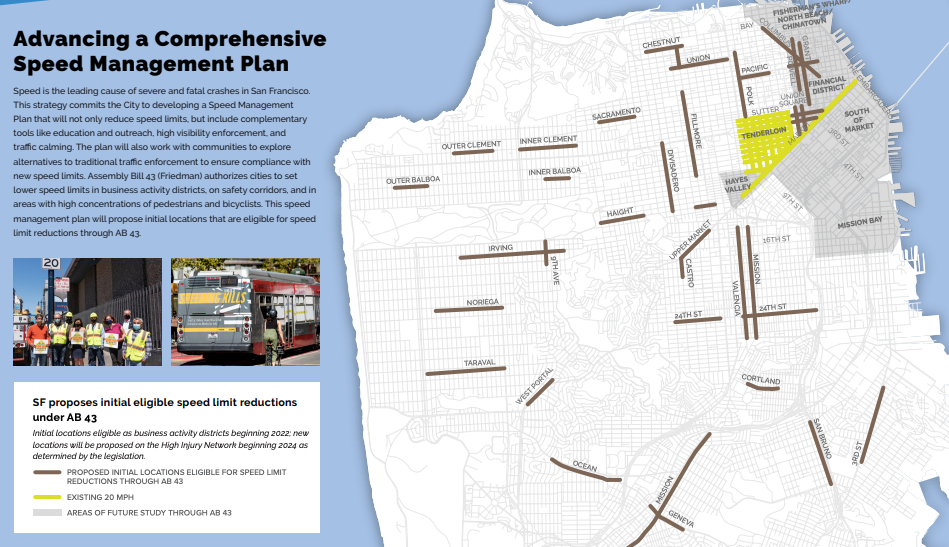
A page from the Vision Zero Action Strategy that outlines San Francisco’s intention to advance a comprehensive speed management plan. Speed is the leading cause of severe and fatal crashes in San Francisco. This strategy commits the City to developing a Speed Management Plan that will not only reduce speed limits, but include complementary tools like education and outreach, high visibility enforcement, and traffic calming. The plan will also work with communities to explore alternatives to traditional traffic enforcement to ensure compliance with new speed limits. Assembly Bill 43 (Friedman) authorizes cities to set lower speed limits in business activity districts, on safety corridors, and in areas with high concentrations of pedestrians and bicyclists. This speed management plan will propose initial locations that are eligible for speed limit reductions through AB 43. The map denotes sections of the following corridors for initial speed reductions: Taraval, Noriega, Irving, 9th Avenue, Outer Balboa, Outer Clement, Inner Clement, Inner Balboa, West Portal, Ocean, Haight, Sacramento, Mission ,Geneva, 24th Street, Upper Market/Castro, Divisadero, Chestnut, Union, Fillmore, Valencia, Cortland, San Bruno, Polk, Pacific, 3rd Street, Union Square, Grant, Powell, and Columbus, Areas for future study include Hayes Valley, Mission Bay, SOMA, the Financial District, Fisherman’s Wharf, North Beach, and Chinatown. The Tenderloin is indicated as an existing 20 mph zone.

As we begin to implement the new Vision Zero Action Strategy, we are keeping equity core to our focus. The Vision Zero HIN is disproportionately concentrated in San Francisco’s communities of color, and vulnerable people—including seniors, people with disabilities, unhoused populations, and people of color—face the greatest risks from traffic-related injuries and deaths. Our Action Strategy prioritizes these communities in engagement, education, and implementation of Vision Zero programs. This past year, we rolled out 20 mph speed limits throughout the Tenderloin, where every street is on the High Injury Network. We are also focused on pursuing legislative authority for new strategies, like speed safety cameras, that are effective in reducing crashes and can reduce racial bias and disparities in enforcement.

This updated strategy commits to bold and ambitious action to get us closer to zero traffic deaths. But to achieve Vision Zero for San Francisco, we know we need the full force of comprehensive policy change, political buy-in, and community support. We need a citywide investment toward lasting, monumental change for our streets. Getting to Vision Zero will take sustained, cross-cutting, and continually innovating action. We’re committed to ending traffic deaths and reducing severe injuries in the city—and will work urgently to save lives on our streets.


Published November 19, 2021 at 03:37AM
https://ift.tt/3CqMNq5

Comments

Popular posts from this blog

Celebrating the life and legacy of Harvey Milk

Celebrating the life and legacy of Harvey Milk By Sophia Scherr Today we celebrate and remember the life of San Francisco LGBTQ+ advocate and icon, Harvey Milk. One of our city’s most revered politicians, Milk's legacy as the first openly gay San Francisco supervisor and elected official in California helped in breaking down discriminatory barriers and usher LGBTQ+ politicians in government positions. Milk also advocated for equitable transportation, as he rode Muni exclusively since he did not own a car. He was a firm believer that affordable mobility was important in creating a thriving and livable city. Below is Harvey Milk with Curtis E. Green, General Manager of the Municipal Railway promoting Muni’s “Fast Pass”. Mr. Green was a barrier-breaking figure in his own right, by becoming the first African American appointed to Muni's top position from his beginnings with the Agency as a bus operator. With his 1974 appointment, Green also became the first African American to ...

By The Numbers: The SFMTA’s COVID-19 Response

By The Numbers: The SFMTA’s COVID-19 Response By Erica Kato The COVID-19 pandemic has brought about unforeseen c hanges to San Francisco’s transportation network. And the impact of the crisis will continue to be felt city-wide long beyond the end of the public health emergency. On March 13, 2020, when it became clear that San Francisco needed immediate adjustments to the transportation system, Director of Transportation Jeff Tumlin launched SFMTA’s Department Operations Center (DOC) team. Since then, the DOC has served as a centralized hub to ensure that we are minimizing health risks to employees and the public as we keep transportation running, both by coordinating internally within the agency and by collaborating closely with our city, state, and federal partners to deploy resources and information in the most effective way possible. San Francisco's response to the COVID-19 pandemic included implementing temporary emergency transit lanes  Our COVID-19 response has chal...

Everyday Heroes: Taxi Driver Corey Lamb

Everyday Heroes: Taxi Driver Corey Lamb By Sarah Hellman Corey Lamb shown without his face mask for the purposes of this photo only. Corey Lamb is a veteran taxi driver with over 10 years of experience, and one of our unsung heroes. Corey provides at least 50 trips each month to wheelchair users who are unable to use Muni's accessible but regular fixed-route service. And during the shelter in place order, he has been actively transporting patients to needed medical appointments — patients like San Francisco resident Amelia Sison. Lamb is representative of the many taxi drivers who are working hard during this health emergency to serve the needs of our most vulnerable residents who need to take trips for essential services. For Sison, Lamb is her lifeline to the community. Since her necessary medical treatments began last year, Lamb has been her regular taxi driver, transporting her at least three times a week to and from appointments. Awarded the 2019 Sys...