By Erin McMillan
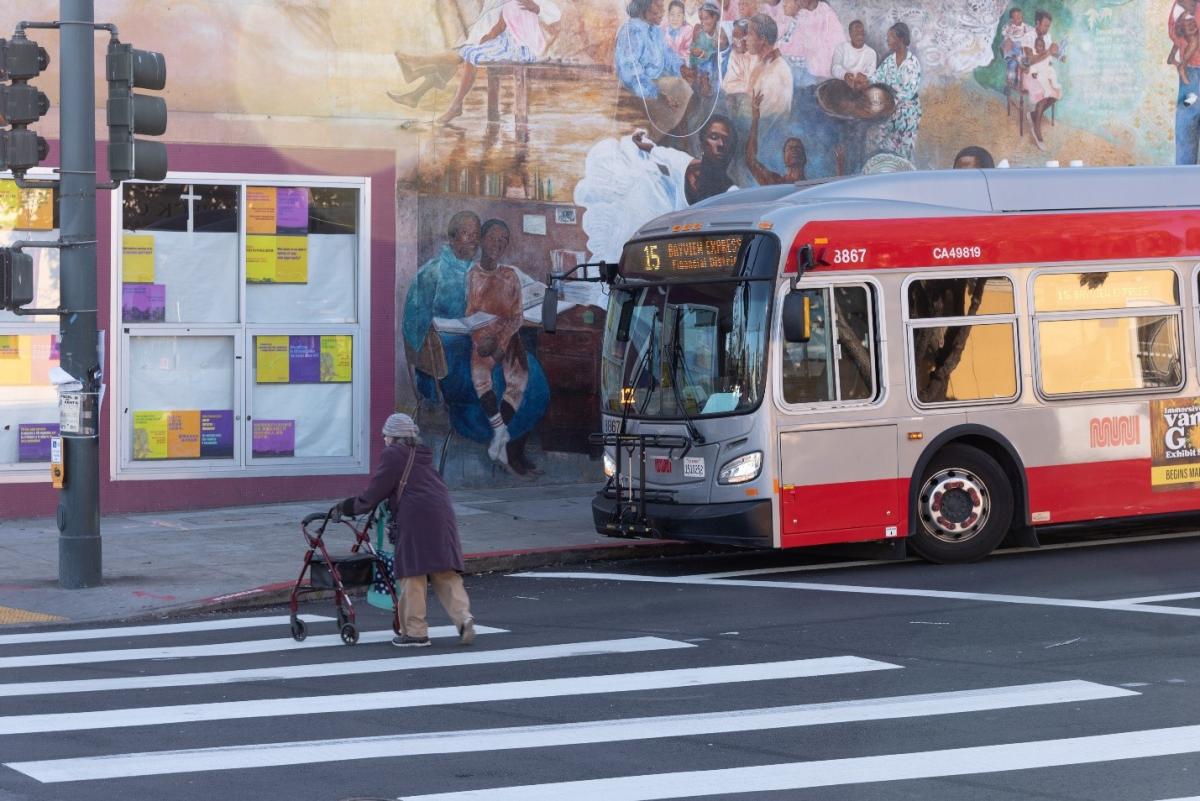 The 15 Bayview Hunters Point Express waits for person crossing the street
Over the past couple of months SFMTA staff have been reaching out for feedback on three alternatives for adding 10% more bus service in early 2022. And we heard you! SFMTA needs to focus on restoring service to provide key connections for people with disabilities and seniors, and that’s what we plan to do. We also heard that there is demand for improving frequency of high-ridership Muni lines to address crowding and wait times, which we'll do with any additional funds.
While we plan for Muni service in early 2022, the city mandate that employees show proof of being fully vaccinated against COVID-19 as a condition of employment will go into effect November 1. We are proud that 82% of SFMTA employees are now fully vaccinated. But if hundreds of our employees are still unvaccinated as of November 1 and are put on leave or terminated, it will significantly impact Muni operations and parking control in San Francisco. This means unexpected gaps in Muni service and lower-than-scheduled frequencies.
While we work on contingency planning for this upcoming challenge, SFMTA staff are taking the feedback we heard about the three alternatives for Muni service additions in early 2022 and developing a proposal that takes into account San Francisco’s priorities for Muni service as well as the potential impacts the vaccine mandate could have on service over the next months. An early 2022 Muni Service Network proposal is expected in early November.
In our survey about expanding Muni service, we presented three alternatives.. Each of these options would go into effect in early 2022. We wanted to learn if Muni customers prefer restoring the seven all-day bus routes that were temporarily suspended since the pandemic started, or whether the resources used to operate those routes would be better used to increase frequency on nearby busy routes to reduce crowding and wait times.
At over 30 stakeholder meetings, neighborhood festivals and pop-ups, and in an online, telephone and in-person survey that received over 4,500 survey responses, we asked the public to balance trade-offs between access and frequency to help us decide how to use available resources for Muni service in early 2022.
We received a significant amount of detailed feedback. For example, some J Church riders find the new surface-only alignment that has addressed delays caused by subway congestion inconvenient, as it means transferring for downtown destinations. Seniors in Japantown are missing a connection to low-cost food service at the Jewish Community Center. People with disabilities and seniors wanted easier and more direct access to St. Mary’s Medical Center.
Now our transit planning team is applying what we heard to develop a proposal that would go to the SFMTA Board for consideration in December. SFMTA staff are sharing what we heard with the public from the survey at Open Houses and Office Hours and will be seeking policy guidance from the SFMTA Board and San Francisco Board of Supervisors in October and November.
As we navigate what the future holds for SFMTA Muni service, we also must identify sustainable long-term revenue sources. In adjusting Muni service, we must make our remaining one-time relief funding from the federal government last until 2024. Without additional revenue, we risk drastic service cuts as soon as 2023. In tandem with our efforts to restore Muni service that best serves San Francisco’s needs, we will be working to identify a path forward for sustainable, long-term funding.
We will keep customers and the public updated about changes to Muni service over the next months. For information about plans for service in early 2022, please visit the 2022 Muni Service Network webpage.
Published October 19, 2021 at 04:20AM
https://ift.tt/3lSoah6
Comments
Post a Comment
If you have any doubt's, please let me know