By Bonnie Jean von Krogh
Transportation is a vital part of a thriving and equitable community and economy. We are planning for a future transportation system to deliver the reliable and safe transit San Franciscans tell us they want, address changes in travel patterns and demographics and improve safety. We also need to address the historical wrongs of inequitable service and long delayed infrastructure repairs.
We have looked at our past and begun charting our future. Transportation in San Francisco is on an unsustainable financial path. We are $50 billion short of the transportation system our city needs over the next 30 years. But we can act now to put San Francisco on a path to success. That’s what Transportation 2050 is about.
Over the last 20 years, the demands on San Francisco’s transportation system have increased while revenues haven’t kept up. The last decade saw tremendous growth in San Francisco and its economy. That strength meant that the SFMTA’s operating revenues met the levels we predicted. Strong growth in the city’s General Fund compensated for the agency’s declining parking and transit fare revenues. Since the SFMTA’s financial structure relies significantly on these declining parking and transit fare revenues, growing costs have resulted in a budget deficit. COVID came along and exacerbated these long-standing budget challenges.
How did we get here? San Francisco has grown and transportation has changed, but how we fund transit and our transportation infrastructure has not. Uber and Lyft have steadily eroded San Francisco's parking revenue, even as we’ve expanded paid parking. Costs to retain reliable, highly qualified bus and rail operators and maintenance staff have increased due to the extraordinarily high costs of living in the Bay Area. Even with this, we have been understaffed for years. Our fare discount programs – critical for keeping Muni affordable – have also meant declining fare revenue.
Now the economic shock and impacts of the COVID-19 pandemic have permanently lowered our revenue projections. At the beginning of the pandemic, we immediately tightened our belts and made $119 million in cuts in a way that prioritized equity. Current federal relief is one-time funding that only keeps transportation afloat in the near term.
With expenditures growing with Bay Area Cost of Living and revenues declining after federal relief is exhausted, the SFMTA faces a funding gap that cannot be closed. It will be years before enterprise revenues recover, leaving the agency on a financial path it cannot recover from alone. A new funding source could get the SFMTA back on track.
Community-Driven Vision
Transportation 2050 is based on transportation needs and priorities identified by the community over the last eight years through two mayoral transportation task forces (T2030 and T2045) and input from the city’s Muni Reliability Working Group in 2020. It outlines the resources needed to achieve the community’s transportation vision developed through ConnectSF, the infrastructure needs identified in the SFMTA’s 20-Year Capital Plan and highlights priorities, post COVID, from the SFMTA’s recent 2021 citywide Community Survey.
Top community priorities include:
- Making our service equitable
- Providing quick, convenient transit access to all parts of San Francisco
- Improving access to public transit for people who are disabled
- Repairing and maintaining Muni equipment and facilities
- Improving service for communities most dependent on transit
- Ensuring that trips to all destinations work well
- Making street safety improvements for walking
Here’s how we're focusing on your priorities and vision:
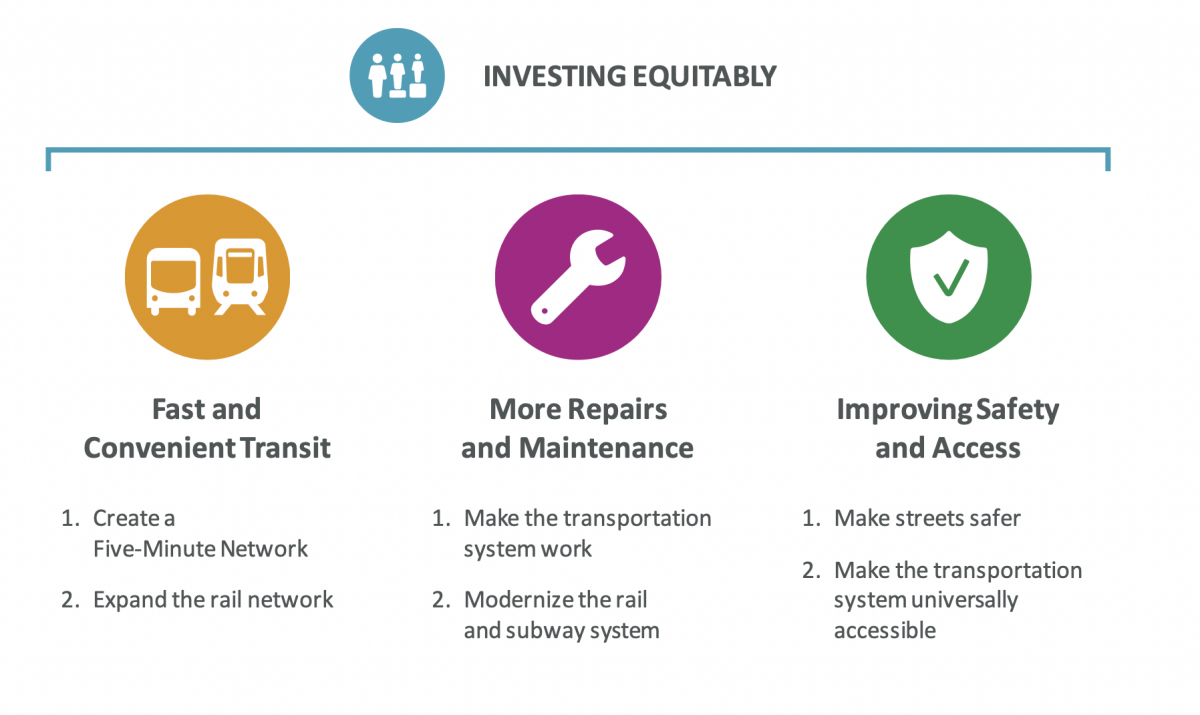
Addressing the needs of San Francisco’s transportation system will require a total of $111.3 billion over the next 30 years, but the costs to deliver on the complete vision are much higher than our revenues can support. Over the next 10 years, the gap between fully implementing this vision and the financial reality we face is $1.04 billion per year on average. We can get part of the way there, but the SFMTA cannot do it alone. We have used most of the tools in our toolbox.
Transportation 2050 has identified some new potential revenue sources, which combined could amount to $149M per year, beginning the process of recovery on which we can build. These include a transportation special tax, changes to San Francisco’s parking tax, a general obligation bond to fix our infrastructure, advocacy for federal and state grants and revenue from the development of SFMTA properties, the newest tool in the SFMTA toolbox. Combining these new sources with existing funds would allow us to fund nearly 2/3 of the transportation vision for San Francisco over 30 years and put our transportation system on the path to firmer financial footing.
Stay tuned for further updates as we work towards achieving this vision while identifying future revenue streams and cost savings strategies to create an equitable and sustainable transportation system for San Francisco. Learn more on our website SFMTA.com/T2050.
Published August 18, 2021 at 02:31AM
https://ift.tt/3za9pKZ
Comments
Post a Comment
If you have any doubt's, please let me know