Young People to Ride Muni for Free

Young People to Ride Muni for Free
By Stephen Chun

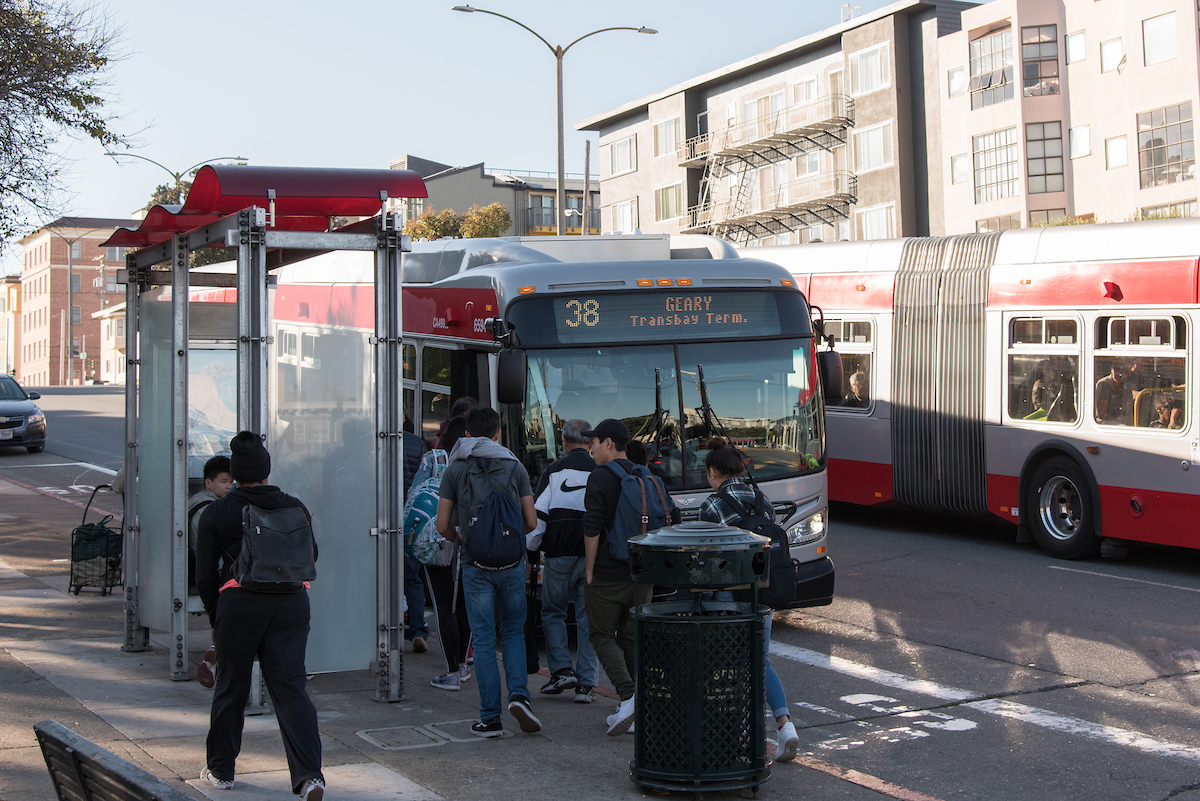
Photo of children boarding the 38 Geary

Mayor London N. Breed, Supervisor Myrna Melgar and the SFMTA have announced the expansion of our Free Muni for Youth Program to include all youth starting August 15, 2021. This is scheduled to coincide with the full in-person return of the San Francisco Unified School District (SFUSD) 2021-2022 school year.

This one-year program will eliminate the application process for all youth under the age of 19 to ride Muni, regardless of financial status and without proof of payment.

There are currently 39,350 active users of the Free Muni for Youth program, representing approximately 72% of those eligible.  Existing participants will no longer need to carry their Clipper Card with the pass or tap the reader when boarding vehicles.

While Muni Transit Fare Inspectors will not request proof of payment from youth who appear to be under the age of 19, youth above the age of 16 are encouraged to carry a student ID or other form of ID for age verification. Youth (San Francisco residents only) who utilize Cable Car service for regular travel can apply for a pass for unlimited travel. Cable car rides for non-resident youth are not covered in the program.

The SFMTA implemented the “Free Muni for Youth” pilot program in 2013 providing free transit service to all low and moderate-income youth in San Francisco aged 5 through 17 years old, and made the program permanent in January 2015. In April 2020, the program was expanded to 18- year-olds and students enrolled in Special Education and English Learner programs through age 22. 

Due to the COVID-19 pandemic, however, the SFMTA lacked the financial resources to continue funding this program moving forward. By allocating $2 million in the upcoming budget, Mayor Breed is ensuring that Muni is accessible to more than 100,000 young people across San Francisco.

Numerous studies have established that exposure to riding transit at an early age leads to continued use in adult years, along with a decrease in auto-ownership. Additional program goals in line with the SFMTA Strategic Plan include creating a safer transportation experience for everyone by improving the safety of the transit system, improving the quality of life and environment in San Francisco and the region by using programs and policies to advance San Francisco’s commitment to equity and finally, ensuring quality of life and economic health in San Francisco that the transportation system is a safe and efficient movement of people and goods.

Free Muni has also been made available for seniors and persons with disabilities. Program eligibility is set at an annual income at or below 100 percent of the Bay Area median. The SFMTA Board of Directors expanded this program in 2020 to persons experiencing homelessness.

For more information about Free Muni for Youth and how to sign up for Cable Car service please visit http://www.sfmta.com.


Published July 13, 2021 at 01:08AM
https://ift.tt/3AVx4jq

Comments

Popular posts from this blog

Slow Streets Program to Help With Social Distancing

Slow Streets Program to Help With Social Distancing By With Muni service temporarily reduced during the COVID-19 health crisis, many San Francisco residents need to walk and take other modes of transportation to make essential trips. However, sometimes it is difficult to maintain 6’ of social distance on many sidewalks, park paths, and bikeways. This can be especially true when passing lines outside grocery stores and other essential services. Because of this, many pedestrians are choosing to walk in the street, exposing themselves to swiftly moving vehicle traffic. The SFMTA is implementing a new program, Slow Streets, to close some streets to through traffic and allow roadways to be used more as a shared space for foot and bicycle traffic. Throughout the city, corridors have been identified for Phase 1 Slow Streets. Beginning this week, some of these streets will be closed to through vehicle traffic to prioritize walking/biking and to provide more space for social distancing duri...

Weight Loss Success Stories: 6 People Share How They Shed Pounds with a High-Protein Diet

Weight Loss Success Stories: 6 People Share How They Shed Pounds with a High-Protein Diet Sarah:  Sarah, a 32-year-old mother of two, struggled with her weight after having her second child. She decided to try a high-protein diet and was able to lose 30 pounds in just three months. She replaced her breakfast with a protein shake, ate a salad with grilled chicken for lunch, and had fish or chicken with vegetables for dinner. Mike:  Mike, a 45-year-old man, had been overweight his entire life. He tried various diets, but none of them worked for him. He decided to give a high-protein diet a try and was able to lose 50 pounds in six months. He ate eggs, chicken, fish, and lean meats for most of his meals and limited his intake of carbohydrates and sugary foods. Emily:  Emily, a 28-year-old woman, had been struggling with her weight since her teenage years. She tried many diets and weight loss programs, but nothing seemed to work for her. She decided to try a high-p...

Celebrating the life and legacy of Harvey Milk

Celebrating the life and legacy of Harvey Milk By Sophia Scherr Today we celebrate and remember the life of San Francisco LGBTQ+ advocate and icon, Harvey Milk. One of our city’s most revered politicians, Milk's legacy as the first openly gay San Francisco supervisor and elected official in California helped in breaking down discriminatory barriers and usher LGBTQ+ politicians in government positions. Milk also advocated for equitable transportation, as he rode Muni exclusively since he did not own a car. He was a firm believer that affordable mobility was important in creating a thriving and livable city. Below is Harvey Milk with Curtis E. Green, General Manager of the Municipal Railway promoting Muni’s “Fast Pass”. Mr. Green was a barrier-breaking figure in his own right, by becoming the first African American appointed to Muni's top position from his beginnings with the Agency as a bus operator. With his 1974 appointment, Green also became the first African American to ...