
Rolling Out the Red on Geary

Rolling Out the Red on Geary
By Amy Fowler

Transit lanes on Geary Boulevard east of Stanyan Street are about to receive the red carpet treatment. And with Geary Rapid Project construction nearing the finish line on time and on budget, it’s the perfect occasion for the corridor to be getting the ruby rollout.

But what’s so magical about the color red? In general, painting transit lanes red has been shown to improve compliance by about 50%. Studies of three downtown San Francisco streets found that red paint led to fewer violations by private vehicles, which reduces the number of collisions and makes Muni service more reliable.

And it makes sense: coloring transit lanes red makes it easier for drivers to know where they’re allowed to drive. By making transit lanes extra clear, you’re less likely to get a citation for unintentionally driving in a transit lane.

Learn about when it’s okay for drivers to access a transit lane.
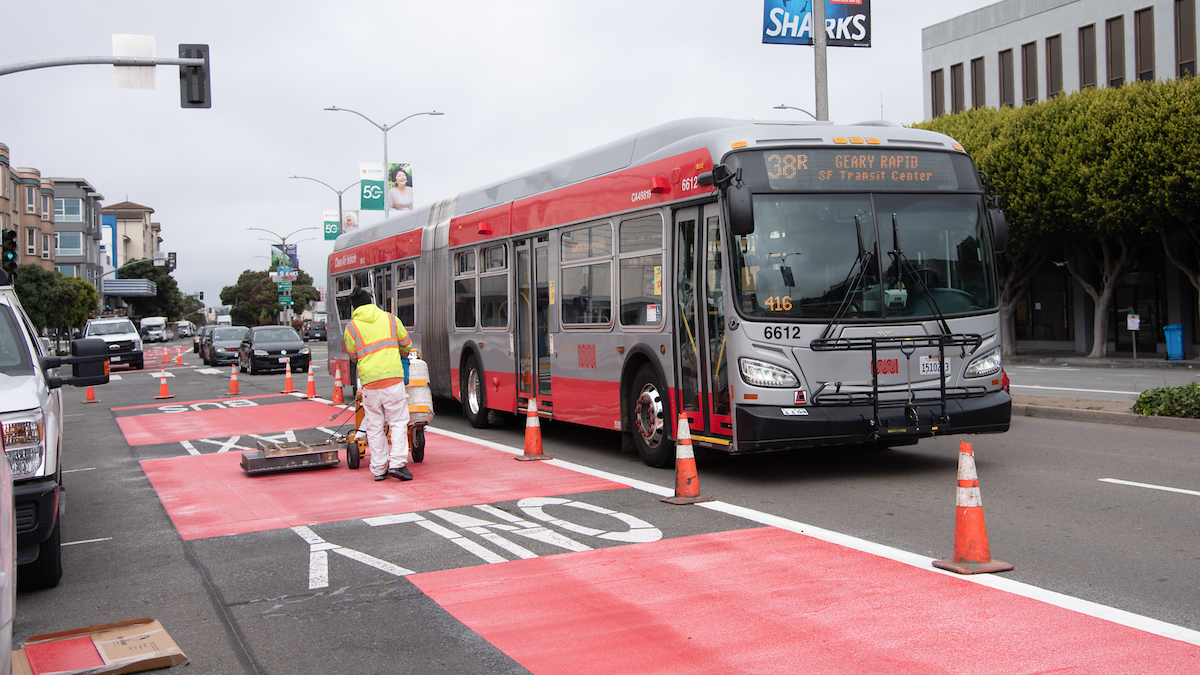
Photo of crew striping street with red paint on Geary
Red transit lanes mark the final step of the transit, safety and utility improvements that are being installed along the Geary corridor between Stanyan and Market streets as part of the Geary Rapid Project.

San Francisco is a leader in using red transit lanes to give buses and trains priority on the street. Following San Francisco’s success, many cities are now using this approach, including New York, Washington, DC, Portland, Seattle, Boston and more.

In the coming months you will start to see new red lanes installed along Geary Boulevard between Stanyan Street and Van Ness Avenue. Then later this fall, after utility and repaving work is completed, existing red lanes will be refreshed and new red lanes will be installed on Geary and O’Farrell streets east of Van Ness.

When the red treatments are completed, Geary will have gained almost 3.5 miles of red lanes along the corridor, bringing the citywide red transit lanes total to 22 miles, or about a 20% increase in red transit line mileage. 

Red lanes along Geary will add to the transit benefits that were realized when quick-build improvements—such as non-colored transit lanes, bus stop changes and traffic signal retiming—were made at the beginning of the Geary Rapid Project in late 2018. Those changes helped to speed up 38R Geary Rapid trips by up to 20% and improved reliability by 20%. In the coming months we’ll be crunching the numbers to understand the additional benefits of the red-colored transit lanes and other recently completed transit improvements like bus bulbs (sidewalk extensions at bus stops).
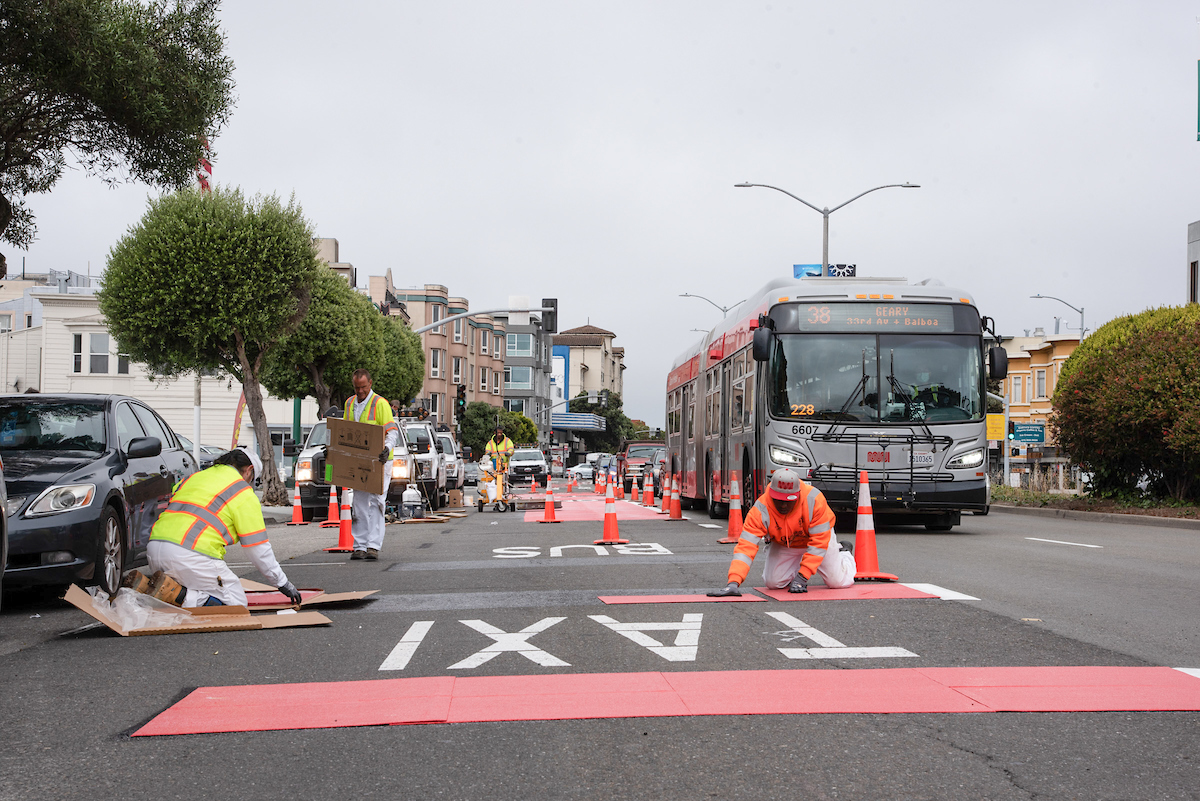
 

Photo of crew finishing red striping of Geary transit lane

Crews put the finishing touches on Geary Boulevard red lanes

Based on the success of San Francisco and other cities’ experiments, the Manual of Uniform Traffic Control Devices (MUTCD)—the national standards governing all traffic control devices—issued Interim Approval to use red transit lane treatments in late 2019. Now the 11th edition of the MUTCD is under development and is expected to include the treatment.


Published July 17, 2021 at 01:34AM
https://ift.tt/3z4ss8S

Comments

Popular posts from this blog

Slow Streets Program to Help With Social Distancing

Slow Streets Program to Help With Social Distancing By With Muni service temporarily reduced during the COVID-19 health crisis, many San Francisco residents need to walk and take other modes of transportation to make essential trips. However, sometimes it is difficult to maintain 6’ of social distance on many sidewalks, park paths, and bikeways. This can be especially true when passing lines outside grocery stores and other essential services. Because of this, many pedestrians are choosing to walk in the street, exposing themselves to swiftly moving vehicle traffic. The SFMTA is implementing a new program, Slow Streets, to close some streets to through traffic and allow roadways to be used more as a shared space for foot and bicycle traffic. Throughout the city, corridors have been identified for Phase 1 Slow Streets. Beginning this week, some of these streets will be closed to through vehicle traffic to prioritize walking/biking and to provide more space for social distancing duri...

Weight Loss Success Stories: 6 People Share How They Shed Pounds with a High-Protein Diet

Weight Loss Success Stories: 6 People Share How They Shed Pounds with a High-Protein Diet Sarah:  Sarah, a 32-year-old mother of two, struggled with her weight after having her second child. She decided to try a high-protein diet and was able to lose 30 pounds in just three months. She replaced her breakfast with a protein shake, ate a salad with grilled chicken for lunch, and had fish or chicken with vegetables for dinner. Mike:  Mike, a 45-year-old man, had been overweight his entire life. He tried various diets, but none of them worked for him. He decided to give a high-protein diet a try and was able to lose 50 pounds in six months. He ate eggs, chicken, fish, and lean meats for most of his meals and limited his intake of carbohydrates and sugary foods. Emily:  Emily, a 28-year-old woman, had been struggling with her weight since her teenage years. She tried many diets and weight loss programs, but nothing seemed to work for her. She decided to try a high-p...

Celebrating the life and legacy of Harvey Milk

Celebrating the life and legacy of Harvey Milk By Sophia Scherr Today we celebrate and remember the life of San Francisco LGBTQ+ advocate and icon, Harvey Milk. One of our city’s most revered politicians, Milk's legacy as the first openly gay San Francisco supervisor and elected official in California helped in breaking down discriminatory barriers and usher LGBTQ+ politicians in government positions. Milk also advocated for equitable transportation, as he rode Muni exclusively since he did not own a car. He was a firm believer that affordable mobility was important in creating a thriving and livable city. Below is Harvey Milk with Curtis E. Green, General Manager of the Municipal Railway promoting Muni’s “Fast Pass”. Mr. Green was a barrier-breaking figure in his own right, by becoming the first African American appointed to Muni's top position from his beginnings with the Agency as a bus operator. With his 1974 appointment, Green also became the first African American to ...