By Samantha Serafica
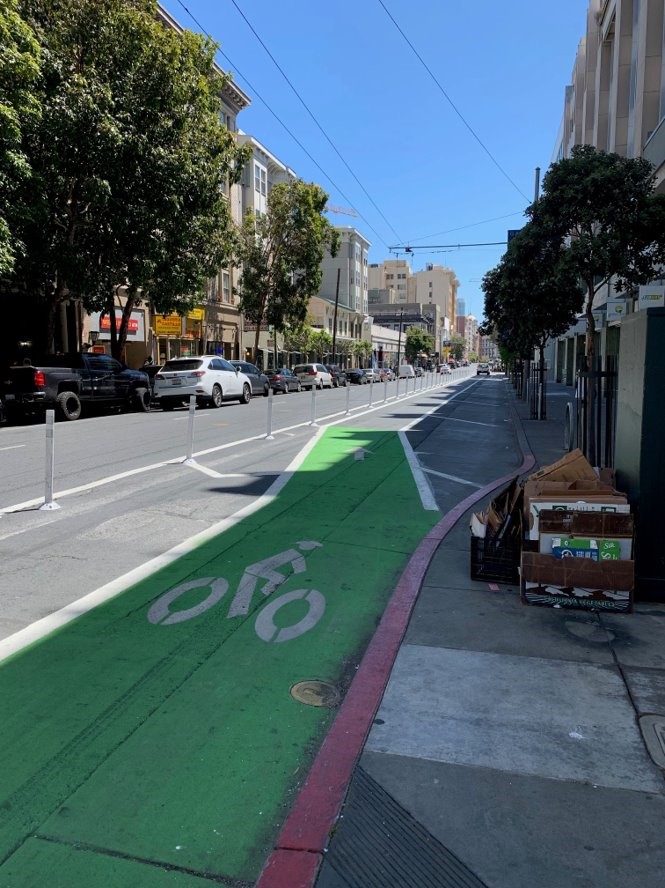
Protected bike lane and active flex space along the 300 block of Golden Gate
Between 2015-2019, the average rate of a person getting hit by a vehicle while walking or biking along the Tenderloin stretch of Golden Gate Avenue and Leavenworth Street was every nine days. The Tenderloin is a densely populated and diverse community located in the heart of San Francisco. It is home to high concentrations of seniors, children, people of color, people experiencing homelessness and people with limited-English proficiency – many of whom live below the poverty line. These groups are most at risk of dying or being severely injured in traffic collisions.
Because of these concerns, the SFMTA launched two quick-build projects on Golden Gate Avenue and Leavenworth Street with preliminary design phases in February 2020. Considering their similar traffic calming goals, physical proximity and shared audience, we pursued a joint outreach campaign for both projects. SFMTA staff began this outreach through door-to-door canvassing, walkalongs, in-person meetings and emails to engage directly with stakeholders and collect project feedback before starting design.
Facing the Pandemic
Unfortunately, public health restrictions associated with the emerging COVID-19 healthy emergency led to a hold on both projects so that staff could allocate resources to address other critical issues that began to arise. To address immediate social distancing and physical space needs in the Tenderloin, the SFMTA worked with community organizations like St. Anthony’s, GLIDE and Tenderloin Community Benefit District (TLCBD) to implement several street improvements such as block closures, physical distancing lanes and temporary vehicle restrictions.
When the projects resumed in fall 2020, COVID-19 health and safety protocols were still in effect and pushed many meetings, typically held in-person, to online formats. We also partnered with the Tenderloin People’s Congress to hold virtual toolkit forums, community workshops and other conversations.
In place of a traditional, one-time, in-person event, staff created a virtual open house with interactive features and information about the projects. Published in seven different languages, the site remained open over a five-week period, allowing greater flexibility for people to view the information and provide feedback. Staff also hosted virtual office hours to provide space for questions and additional comments. Following the virtual open house, both projects held a public hearing in April 2021 and were cleared to start construction in May.
Impact
Every street in the Tenderloin is on the city’s Vision Zero High Injury Network, the 13% of city streets where 75% of severe and fatal collision occur. The COVID-19 pandemic only exacerbated the challenges of addressing the safety needs of the neighborhood. Now, our recently constructed quick-builds on Golden Gate Avenue and Leavenworth Street are helping to address the unsafe vehicle speeds and failures to yield that have made up the majority of traffic incidents in the Tenderloin.
The relationships built from the Safer Taylor project provided a foundation to continue conversations with the community about traffic safety improvements in the neighborhood. Staff began outreach through door-to-door canvassing, walkalongs, in-person meetings and emails to engage directly with stakeholders and collect project feedback before starting design.
Throughout construction, SFMTA staff continued to collaborate with local partners such as Code Tenderloin and TLCBD to provide construction notifications to businesses and residents on the corridors. Both Golden Gate and Leavenworth street changes brought innovative quick-build improvements to the Tenderloin, such as an active flex space, and bringing these projects to life under COVID-19 required creativity, flexibility and strong community support.
What’s Next
Partnering with community organizations allows SFMTA staff to engage with stakeholders that would have otherwise been unreachable due to public safety concerns. While quick-build construction is complete, our work in the Tenderloin will continue. Some next steps include evaluating the quick-builds, exploring potential future projects and transitioning some of our COVID-19 emergency streets to quick-build improvements. Community partnerships with local groups and individual residents will continue to sustain and strengthen our work in the Tenderloin.
Published June 18, 2021 at 03:53AM
https://ift.tt/3xv6Lhr
Comments
Post a Comment
If you have any doubt's, please let me know