
Safer and Easier Parking in Every City-Owned Facility

Safer and Easier Parking in Every City-Owned Facility
By Pamela Johnson

Parking at any of our 22 city-owned facilities is now easier and safer than ever. Late last month we completed the Parking Access Revenue and Control Systems (PARCS) project. This four-year effort replaced aging parking equipment with modern technology and significant operational upgrades.
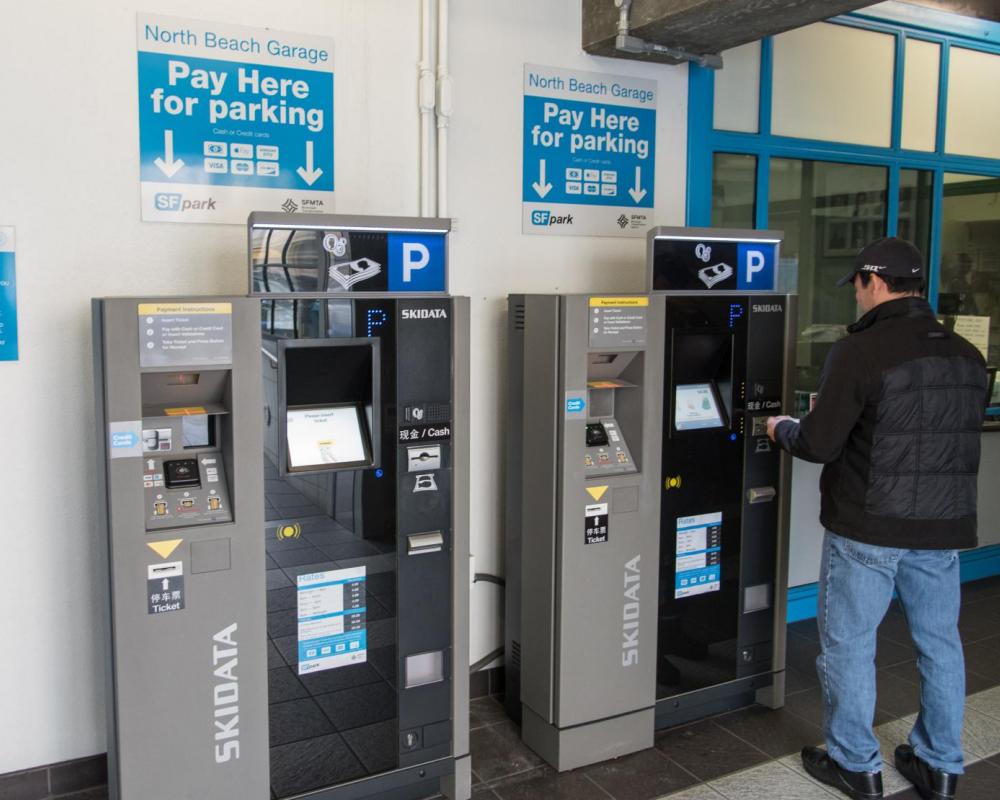
Photo of Customer using new PARCS kiosk at North Beach parking garage

Customer using new PARCS kiosk at North Beach parking garage

Patrons will notice enhanced lighting, new wayfinding signs, audible alarms, cameras, gate arms, and payment machines with two-way digital intercoms. Behind the scenes is an all-new parking management system and 24/7 command center, connected to every machine.

Can’t find your ticket to pay for parking?  No worries!

Thanks to license plate recognition technology, cameras located at every facility’s entrance capture patrons’ plate numbers as they arrive. If a customer loses her ticket, the manager is able to re-issue a ticket based on her license plate number. Previously, the customer would have been required to pay for a full day of parking.

Safety and Ease of Use

“The new system is a significant operational upgrade from our prior 16-year-old equipment” said Robert Aicardi, Operations Manager of SFMTA’s Off-Street Parking unit. Aicardi, who oversaw the day-to-day delivery of the PARCS upgrade project, noted that “The upgrades make for easier and safer access in and out of a parking facility and a better experience.”

Ted Graff, the Director of Parking & Curb Management added that “Thanks to modern technology, we can better manage the customer parking experience in our parking facilities and facility operations. We’ve also improved auditing and credit card security to protect customers, enabled real-time data collection, which helps with the implementation of dynamic or demand-responsive pricing and enabled universal validation to create a more efficient parking experience.”

Highlights

  • All payment machines have instructions in English, Chinese, and Spanish
  • Cameras have been installed at every point of sale and point of entry/exit to augment the intercoms
  • Both flashing lights and audible alarms are activated as vehicles exit the facility, improving safety in areas of high pedestrian traffic 
  • Payment kiosks use industry-standard, end-to-end encryption for credit card transactions
  • Every point of sale enables mobile app contactless payments (including. Android Pay and Apple)

 PARCS partners

 To complete the upgrades, SFMTA’s Streets Division Off-Street Parking unit provided day-to-day oversight of the project, in partnership with SKIDATA, the PARCS vendor. Walker Parking Consultants served as the architect of record, and San Francisco Public Works oversaw all demolition and utility upgrades, which preceded PARCS equipment installation.

Visit the SFMTA’s website to learn more about the PARCS project and see a map of Garages & Lots that received the PARCS upgrades.


Published April 27, 2021 at 01:55AM
https://ift.tt/3gENB3o

Comments

Popular posts from this blog

Slow Streets Program to Help With Social Distancing

Slow Streets Program to Help With Social Distancing By With Muni service temporarily reduced during the COVID-19 health crisis, many San Francisco residents need to walk and take other modes of transportation to make essential trips. However, sometimes it is difficult to maintain 6’ of social distance on many sidewalks, park paths, and bikeways. This can be especially true when passing lines outside grocery stores and other essential services. Because of this, many pedestrians are choosing to walk in the street, exposing themselves to swiftly moving vehicle traffic. The SFMTA is implementing a new program, Slow Streets, to close some streets to through traffic and allow roadways to be used more as a shared space for foot and bicycle traffic. Throughout the city, corridors have been identified for Phase 1 Slow Streets. Beginning this week, some of these streets will be closed to through vehicle traffic to prioritize walking/biking and to provide more space for social distancing duri...

Weight Loss Success Stories: 6 People Share How They Shed Pounds with a High-Protein Diet

Weight Loss Success Stories: 6 People Share How They Shed Pounds with a High-Protein Diet Sarah:  Sarah, a 32-year-old mother of two, struggled with her weight after having her second child. She decided to try a high-protein diet and was able to lose 30 pounds in just three months. She replaced her breakfast with a protein shake, ate a salad with grilled chicken for lunch, and had fish or chicken with vegetables for dinner. Mike:  Mike, a 45-year-old man, had been overweight his entire life. He tried various diets, but none of them worked for him. He decided to give a high-protein diet a try and was able to lose 50 pounds in six months. He ate eggs, chicken, fish, and lean meats for most of his meals and limited his intake of carbohydrates and sugary foods. Emily:  Emily, a 28-year-old woman, had been struggling with her weight since her teenage years. She tried many diets and weight loss programs, but nothing seemed to work for her. She decided to try a high-p...

By The Numbers: The SFMTA’s COVID-19 Response

By The Numbers: The SFMTA’s COVID-19 Response By Erica Kato The COVID-19 pandemic has brought about unforeseen c hanges to San Francisco’s transportation network. And the impact of the crisis will continue to be felt city-wide long beyond the end of the public health emergency. On March 13, 2020, when it became clear that San Francisco needed immediate adjustments to the transportation system, Director of Transportation Jeff Tumlin launched SFMTA’s Department Operations Center (DOC) team. Since then, the DOC has served as a centralized hub to ensure that we are minimizing health risks to employees and the public as we keep transportation running, both by coordinating internally within the agency and by collaborating closely with our city, state, and federal partners to deploy resources and information in the most effective way possible. San Francisco's response to the COVID-19 pandemic included implementing temporary emergency transit lanes  Our COVID-19 response has chal...