
An Update on Cable Cars and Muni's Historic Fleet

An Update on Cable Cars and Muni's Historic Fleet
By Erica Kato

Unbeatable views. Unforgettable trips. No experience is more uniquely San Francisco than a ride on a cable car. Cable cars have come to symbolize our great city.  
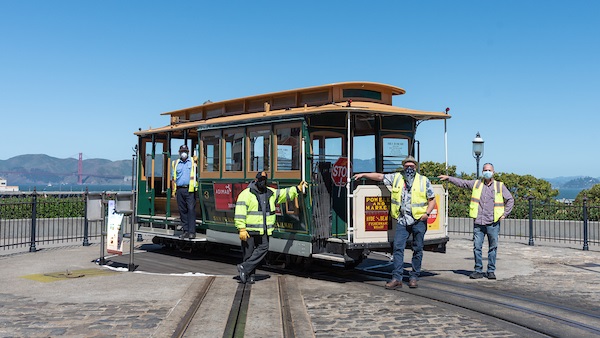
Phot of the Powell/Hyde Cable Car above Fishermans Wharf

The Powell/Hyde Cable Car turnaround at Fisherman's Wharf

Last March, in response to the COVID-19 pandemic, we temporarily halted cable car service as part of the city’s emergency response. This decision was made to best protect our operators and the public. Muni resources were then shifted to a core network to serve our essential workers and accommodate physical distancing on our most utilized lines and to retain access for transit dependent neighborhoods.  

We’re excited to announce that we have a timeline to phase in cable car service, as well as bring back service on our historic F Line fleet. Thanks to the acceleration of the COVID-19 vaccine and a more optimistic outlook for federal funding for public transit, we can craft a path forward. Our plan is to resume F Line service this May, seven days a week. Cable car service will return on the Powell-Hyde line, between Market Street and Fisherman’s Wharf, first this fall — ahead of the holiday season. The cable cars run through the heart of the city and will play a fundamental role in helping the city’s economy recover. What we know is tourism is the main driver of city business, and cable cars are a huge draw to San Francisco. 

In the meantime, we have a lot of work ahead of us before service returns: retraining operators, hiring line inspectors, and preparing our infrastructure to accommodate daily ridership again.   

We are committed to restarting cable car service and are well aware of the tremendous value they have for San Francisco’s history and economy. Please subscribe to our text or e-mail updates for more information on their triumphant return to San Francisco’s hilly streets and most iconic backdrops.  


Published March 03, 2021 at 08:48PM
https://ift.tt/3sRp1iV

Comments

Popular posts from this blog

Celebrating the life and legacy of Harvey Milk

Celebrating the life and legacy of Harvey Milk By Sophia Scherr Today we celebrate and remember the life of San Francisco LGBTQ+ advocate and icon, Harvey Milk. One of our city’s most revered politicians, Milk's legacy as the first openly gay San Francisco supervisor and elected official in California helped in breaking down discriminatory barriers and usher LGBTQ+ politicians in government positions. Milk also advocated for equitable transportation, as he rode Muni exclusively since he did not own a car. He was a firm believer that affordable mobility was important in creating a thriving and livable city. Below is Harvey Milk with Curtis E. Green, General Manager of the Municipal Railway promoting Muni’s “Fast Pass”. Mr. Green was a barrier-breaking figure in his own right, by becoming the first African American appointed to Muni's top position from his beginnings with the Agency as a bus operator. With his 1974 appointment, Green also became the first African American to ...

By The Numbers: The SFMTA’s COVID-19 Response

By The Numbers: The SFMTA’s COVID-19 Response By Erica Kato The COVID-19 pandemic has brought about unforeseen c hanges to San Francisco’s transportation network. And the impact of the crisis will continue to be felt city-wide long beyond the end of the public health emergency. On March 13, 2020, when it became clear that San Francisco needed immediate adjustments to the transportation system, Director of Transportation Jeff Tumlin launched SFMTA’s Department Operations Center (DOC) team. Since then, the DOC has served as a centralized hub to ensure that we are minimizing health risks to employees and the public as we keep transportation running, both by coordinating internally within the agency and by collaborating closely with our city, state, and federal partners to deploy resources and information in the most effective way possible. San Francisco's response to the COVID-19 pandemic included implementing temporary emergency transit lanes  Our COVID-19 response has chal...

Slow Streets Program to Help With Social Distancing

Slow Streets Program to Help With Social Distancing By With Muni service temporarily reduced during the COVID-19 health crisis, many San Francisco residents need to walk and take other modes of transportation to make essential trips. However, sometimes it is difficult to maintain 6’ of social distance on many sidewalks, park paths, and bikeways. This can be especially true when passing lines outside grocery stores and other essential services. Because of this, many pedestrians are choosing to walk in the street, exposing themselves to swiftly moving vehicle traffic. The SFMTA is implementing a new program, Slow Streets, to close some streets to through traffic and allow roadways to be used more as a shared space for foot and bicycle traffic. Throughout the city, corridors have been identified for Phase 1 Slow Streets. Beginning this week, some of these streets will be closed to through vehicle traffic to prioritize walking/biking and to provide more space for social distancing duri...