By Erin McMillan
In January, along with other proposed and planned key locations across the city, the SFMTA Board of Directors approved temporary emergency transit lanes for the 4th Street Bridge. These temporary lanes address a key bottleneck that delays the T Third line on 4th Street northbound and southbound between Berry and Channel Streets.
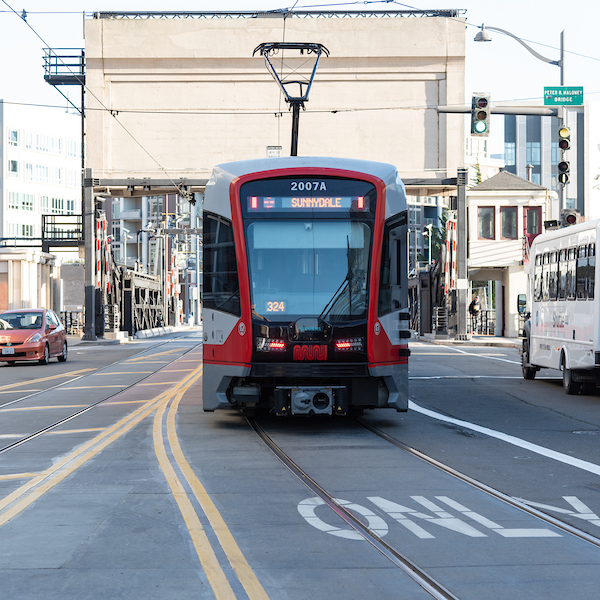
A Sunnydale-bound T Third train approaches the 4th Street Bridge
As a response to community feedback, the project team developed a two-phase implementation of the temporary transit lanes to allow for an evaluation of their effectiveness before fully restricting northbound bridge traffic.
The initial evaluation of the first phase has been completed, and data shows that partial implementation was effective in allowing Muni trains to travel across the bridge with little delay.
Currently, northbound left turns are restricted from 4th Street onto Berry Street. The previous left turn pocket at that location was converted to a temporary transit lane, while northbound through-traffic continues to be allowed on the bridge. As the city emerges from the public health order to less restrictive tiers, we will perform an additional evaluation of the existing Phase 1 implementation. If that analysis determines that northbound private vehicle traffic on the bridge has begun to cause delays to the T Third, the single northbound lane will be restricted temporarily to transit only between Berry and Channel Streets as a second phase of the project.
A summary of this phased approach is provided below.
Phase 1: Complete. Evaluation of this phase began after the T Third resumed service in late January:
- A southbound temporary emergency transit lane was installed in one of the two southbound lanes on the 4th Street Bridge
- Northbound left turns are now temporarily prohibited from 4th Street onto Berry Street
- The left turn pocket in the northbound direction from 4th onto Berry Street was converted to a temporary transit lane
Phase 2: If a change in emergency order tiers shows that traffic is causing transit delay on the 4th Street Bridge:
- A northbound temporary transit-only lane will be installed in the sole northbound lane on the 4th Street Bridge
- Northbound traffic will not be permitted on the 4th Street Bridge, with these additional temporary restrictions:
- Heading north on 4th Street at Channel, no through traffic onto the 4th Street Bridge (right or left turn required)
- Heading east on Channel, no left turn onto the 4th Street Bridge
- Heading west on Channel, no right turn onto the 4th Street Bridge
- Southbound general traffic will continue to be permitted
Evaluation of the phased approach
Our Phase 1 evaluation included site visits and several weeks of monitoring traffic on and around the 4th Street Bridge. Our chief metric was whether general traffic blocked trains on the shared northbound lane across the 4th Street Bridge. If northbound traffic blocked trains more than 5% of the time, our plan was to implement Phase 2. Periods of evaluation included morning, mid-day, and afternoon/evening peak.
We also monitored train travel times using location data from T Third train tracking devices to identify when trains experienced the longest travel times on the 4th Street Bridge. Because this data showed few instances when trains were blocked by northbound traffic, we paused implementation of the second phase.
Initial Phase 1 Evaluation Results
Our data demonstrated that Phase 1 was successful in decreasing transit delays and protecting trains from traffic congestion. With the temporary emergency transit lanes in place:
- On average, overall transit delay decreased by 63% at the of 4th and Berry streets.
- T Third trains are now 2.5 times more likely to travel through the 4th and Berry street intersection without having to stop for a red light.
- When trains do encounter a red light, the average wait time for a green signal is 70% shorter
- With Phase 1 in place, T Third trains were delayed by traffic congestion less than 1% of the time
Next steps
Our ongoing evaluation of the project will include a community survey in mid-March as well as continued technical evaluation of the effectiveness of these temporary transit lanes. A renewed technical evaluation will take place with the changing of tiers in the city’s emergency public heath order.
For additional information on this project, and to sign up for updates, check out the 4th Street Bridge Temporary Emergency Transit Lanes webpage.
Published March 18, 2021 at 02:48AM
https://ift.tt/3vzBjP1
Comments
Post a Comment
If you have any doubt's, please let me know