
Mask Up - It's the Law!

Mask Up - It's the Law!
By Kristen Holland

You may hear a new announcement on our vehicles or see new messages about masks being required by federal law. The spread of COVID-19 has led the federal government to enact a mask requirement for all public transportation conveyances. Here in San Francisco, that law means wearing a mask in Muni stations, when purchasing a ticket and while waiting for, boarding, riding or exiting transit. Failure to wear a mask can result in denial of boarding, removal from Muni and may carry federal penalties.

Muni customers are doing great when it comes to mask compliance, which consistently exceeds 95% (see chart). You get it. Wearing masks, physically distancing and riding Muni for only essential trips remain crucial to reducing the spread of COVID-19.
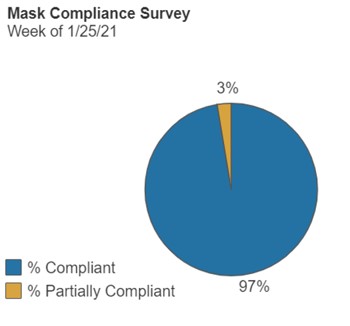
Chart showing 97 percent mask compliance and 3 percent partial compliance for the week of 1/25/2021

The SFMTA mask survey for the final week of January 2021 reported 97% compliance

And every week, our operators, fare inspectors and ambassadors hand out thousands of masks to those who don’t have one. Thank you for protecting our employees and each other.
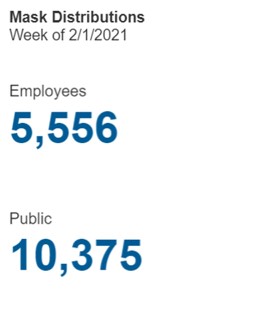
The SFMTA distributed 5,556 masks to employees and 10,375 masks to the public during the first week of February 2021

During the first week of February 2021, the SFMTA distributed nearly 16,000 masks

Here’s more on the new law:

The federal mask requirement went into effect earlier this month and will continue until May 2021.

As a reminder, a properly worn mask:

  • Completely covers the nose and mouth of the wearer
  • Is secured to the head, including with ties or ear loops
  • Fits snugly against the side of the face.

Face shields do not fulfill the requirements of the law. Instead, masks should be a solid piece of material without slits, exhalation valves, or punctures. Face coverings like scarves and bandanas do not meet this requirement. Visit the CDC website for tips on improving your mask to protect yourself and others.

Like other mask requirements, the law allows for some exemptions and exceptions. For example, the temporary removal of a mask is allowed in order to:

  • Take oral medications for brief periods.
  • Communicate with a person who is deaf or hard of hearing, when the ability to see the mouth is essential for communication.

The specifics of the federal law are outlined in the Transportation Security Administration Security Directive.

All state and local public health orders remain in effect.  For more information, visit SFMTA.com/COVID or call 311 within San Francisco or 415-701-4311. Free language assistance available.


Published February 16, 2021 at 10:54PM
https://ift.tt/37nngSe

Comments

Popular posts from this blog

Celebrating the life and legacy of Harvey Milk

Celebrating the life and legacy of Harvey Milk By Sophia Scherr Today we celebrate and remember the life of San Francisco LGBTQ+ advocate and icon, Harvey Milk. One of our city’s most revered politicians, Milk's legacy as the first openly gay San Francisco supervisor and elected official in California helped in breaking down discriminatory barriers and usher LGBTQ+ politicians in government positions. Milk also advocated for equitable transportation, as he rode Muni exclusively since he did not own a car. He was a firm believer that affordable mobility was important in creating a thriving and livable city. Below is Harvey Milk with Curtis E. Green, General Manager of the Municipal Railway promoting Muni’s “Fast Pass”. Mr. Green was a barrier-breaking figure in his own right, by becoming the first African American appointed to Muni's top position from his beginnings with the Agency as a bus operator. With his 1974 appointment, Green also became the first African American to ...

By The Numbers: The SFMTA’s COVID-19 Response

By The Numbers: The SFMTA’s COVID-19 Response By Erica Kato The COVID-19 pandemic has brought about unforeseen c hanges to San Francisco’s transportation network. And the impact of the crisis will continue to be felt city-wide long beyond the end of the public health emergency. On March 13, 2020, when it became clear that San Francisco needed immediate adjustments to the transportation system, Director of Transportation Jeff Tumlin launched SFMTA’s Department Operations Center (DOC) team. Since then, the DOC has served as a centralized hub to ensure that we are minimizing health risks to employees and the public as we keep transportation running, both by coordinating internally within the agency and by collaborating closely with our city, state, and federal partners to deploy resources and information in the most effective way possible. San Francisco's response to the COVID-19 pandemic included implementing temporary emergency transit lanes  Our COVID-19 response has chal...

Slow Streets Program to Help With Social Distancing

Slow Streets Program to Help With Social Distancing By With Muni service temporarily reduced during the COVID-19 health crisis, many San Francisco residents need to walk and take other modes of transportation to make essential trips. However, sometimes it is difficult to maintain 6’ of social distance on many sidewalks, park paths, and bikeways. This can be especially true when passing lines outside grocery stores and other essential services. Because of this, many pedestrians are choosing to walk in the street, exposing themselves to swiftly moving vehicle traffic. The SFMTA is implementing a new program, Slow Streets, to close some streets to through traffic and allow roadways to be used more as a shared space for foot and bicycle traffic. Throughout the city, corridors have been identified for Phase 1 Slow Streets. Beginning this week, some of these streets will be closed to through vehicle traffic to prioritize walking/biking and to provide more space for social distancing duri...