By Shannon Hake
In locations throughout San Francisco, the Slow Streets Program has shown that minimizing traffic on residential streets allows them to be more safely used as a space for people traveling by foot and by bicycle. Due to the program’s success, the SFMTA is now exploring the possibility of making some of the current temporary Slow Streets permanent, extending their use beyond the COVID-19 emergency.
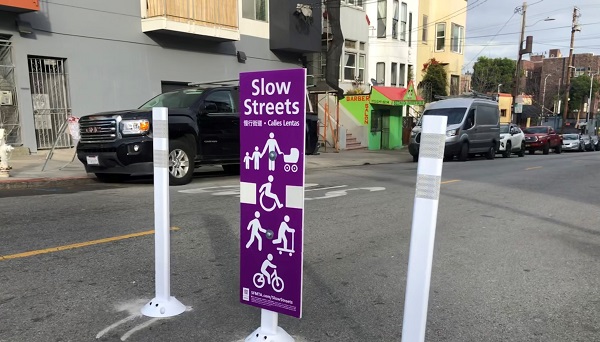
Slow Streets discourage non-local vehicle access through barricades and signage. Reducing the number of vehicles on Slow Streets provides more space for physically-distanced essential travel and exercise during the COVID-19 emergency. Because of their popularity, community members have indicated a strong interest in a longer-term future for these streets. As such, we are planning ahead so that some Slow Streets can be maintained beyond the public health emergency.
In the coming months we’ll be implementing our “Path to Permanence” on the first three Slow Streets corridors: Page Street, Shotwell Street, and Sanchez Street. These are corridors where our resident and user surveys have shown strong community support for Slow Streets. The positive feedback from these surveys has shown that residents and users of these Slow Streets overwhelmingly support making them permanent. After completing the planning process with these three streets, we’ll explore other streets in the network using the same process:
- Determine Support for Permanence: We survey the residents living along all of our Slow Streets to better understand the desire to make the designation permanent. These surveys are ongoing and will be completed on all Slow Streets corridors by May.
- Listen to the Community: On streets with strong support, we engage with residents and stakeholders on potential permanent treatments. These could include operational changes like turn restrictions or other physical changes with more durable materials, beyond the temporary delineator treatment currently in place on some Slow Streets.
- Design Permanent Treatments: Using the feedback from the community, our engineers and planners will complete the permanent Slow Streets design, which will consist of uniform elements. We’ll meet with the community again to share this design and address any outstanding concerns.
- Approve Permanent Changes and Slow Streets Designation: Following a public hearing process and other internal review, we’ll present permanent corridor changes to the SFMTA Board of Directors for final approval.
What’s Next
The SFMTA has implemented 25 temporary Slow Streets since April 2020. Identifying which corridors have support for being made permanent will take time. We plan to survey residents along all temporary Slow Streets corridors by May 2021 to determine which corridors may advance to permanence.
The Slow Streets network continues to evolve, and will expand to include 13 additional temporary corridors if our proposal is approved at the SFMTA Board of Directors meeting on February 16. These new corridors will go through the process outlined above to determine whether they should be considered permanent.
For updates, additional information, and to provide input, visit our Slow Streets Program page.
Published January 28, 2021 at 04:47AM
https://ift.tt/3t0mPX3
Comments
Post a Comment
If you have any doubt's, please let me know