
San Francisco Launches Safety - It’s Your Turn Campaign

San Francisco Launches Safety - It’s Your Turn Campaign
By Christine Osorio

In San Francisco, left turns are one of the top three crash factors in severe injuries and fatal collisions for people walking and biking. SFMTA is kicking off the new year with a city-wide education campaign designed to encourage safer driving behavior around left turns. The Safety - It’s Your Turn campaign will use multiple strategies, including grants to community organizations, to engage the public at different times and raise awareness about unsafe left turns.

Drivers especially will see the Safety - It’s Your Turn messaging on billboards and buses, hear about it on the radio, and read about it on social media and in newspapers. This community education program also accompanies the SFMTA’s Left-Turn Traffic Calming Project.  Under that project, launched in October 2020, the SFMTA installed safety infrastructure at 7 intersections on the High Injury Network.
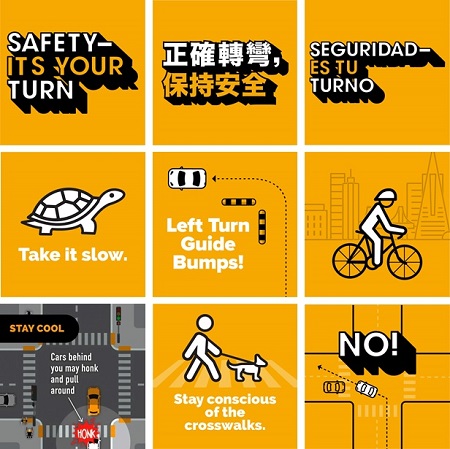
nine posters with these messages: "safety it's your turn" in english, chinese and spanish, "take it slow" with an image of a turtle, "left turn guide bumps" with an image of a car turning left by guide bumps, an image of a cyclist wearing a helmet, "stay cool" because "cars behind you may honk and pull around", an image of a human walking a dog with the message "stay conscious of the sidewalks", and an image of a car turning left encroaching the wrong lane with the message "no"

Community Grant Awardees

After a competitive application process, the SFMTA has awarded six grants to community organizations around the city to amplify the Safety It’s Your Turn campaign.  Community organizations are closer to the communities they serve and are better positioned to develop culturally-responsive outreach programs and materials. In addition to sharing safe left-turn messaging, another objective of the grant is to reach communities historically underserved by transportation projects. For many of the organizations, this is their first-time developing Vision Zero messaging, and the SFMTA is pleased to be expanding its engagement with community stakeholders and leaders. The selected grantees include:

These community groups plan to share safe left-turn messaging directly to food-delivery drivers, hard-to-reach communities along the High Injury Network, teen drivers, and vulnerable road-users. Examples of the deliverables include map booklets for the visually impaired, teen driver safety kits, and art-inspired public service announcements.

Remember that 40% of traffic fatalities in San Francisco involve drivers making left turns. Drivers can make a safe left turn by yielding to pedestrians and bicyclists, taking it slow at less than 5 mph, and making their turn nice and wide.
Image with the caption "anatomy of a left turn" with a link to video

Watch: Anatomy of a Left Turn

Vision Zero

San Francisco adopted Vision Zero (www.visionzerosf.org)as a policy in 2014, committing to build better and safer streets, educate the public on traffic safety, enforce traffic laws, and adopt policy changes that save lives. The result of this collaborative, citywide effort is safer, more livable streets as San Francisco works towards the Vision Zero goal of zero traffic fatalities. San Francisco is engineering inherently safer streets, enforcing traffic laws more effectively, and targeting traffic-safety education to reach its Vision Zero goals.


Published January 21, 2021 at 10:00PM
https://ift.tt/3c1gvbY

Comments

Popular posts from this blog

Celebrating the life and legacy of Harvey Milk

Celebrating the life and legacy of Harvey Milk By Sophia Scherr Today we celebrate and remember the life of San Francisco LGBTQ+ advocate and icon, Harvey Milk. One of our city’s most revered politicians, Milk's legacy as the first openly gay San Francisco supervisor and elected official in California helped in breaking down discriminatory barriers and usher LGBTQ+ politicians in government positions. Milk also advocated for equitable transportation, as he rode Muni exclusively since he did not own a car. He was a firm believer that affordable mobility was important in creating a thriving and livable city. Below is Harvey Milk with Curtis E. Green, General Manager of the Municipal Railway promoting Muni’s “Fast Pass”. Mr. Green was a barrier-breaking figure in his own right, by becoming the first African American appointed to Muni's top position from his beginnings with the Agency as a bus operator. With his 1974 appointment, Green also became the first African American to ...

By The Numbers: The SFMTA’s COVID-19 Response

By The Numbers: The SFMTA’s COVID-19 Response By Erica Kato The COVID-19 pandemic has brought about unforeseen c hanges to San Francisco’s transportation network. And the impact of the crisis will continue to be felt city-wide long beyond the end of the public health emergency. On March 13, 2020, when it became clear that San Francisco needed immediate adjustments to the transportation system, Director of Transportation Jeff Tumlin launched SFMTA’s Department Operations Center (DOC) team. Since then, the DOC has served as a centralized hub to ensure that we are minimizing health risks to employees and the public as we keep transportation running, both by coordinating internally within the agency and by collaborating closely with our city, state, and federal partners to deploy resources and information in the most effective way possible. San Francisco's response to the COVID-19 pandemic included implementing temporary emergency transit lanes  Our COVID-19 response has chal...

Slow Streets Program to Help With Social Distancing

Slow Streets Program to Help With Social Distancing By With Muni service temporarily reduced during the COVID-19 health crisis, many San Francisco residents need to walk and take other modes of transportation to make essential trips. However, sometimes it is difficult to maintain 6’ of social distance on many sidewalks, park paths, and bikeways. This can be especially true when passing lines outside grocery stores and other essential services. Because of this, many pedestrians are choosing to walk in the street, exposing themselves to swiftly moving vehicle traffic. The SFMTA is implementing a new program, Slow Streets, to close some streets to through traffic and allow roadways to be used more as a shared space for foot and bicycle traffic. Throughout the city, corridors have been identified for Phase 1 Slow Streets. Beginning this week, some of these streets will be closed to through vehicle traffic to prioritize walking/biking and to provide more space for social distancing duri...