Unclog Fog City

Unclog Fog City
By Bradley Dunn

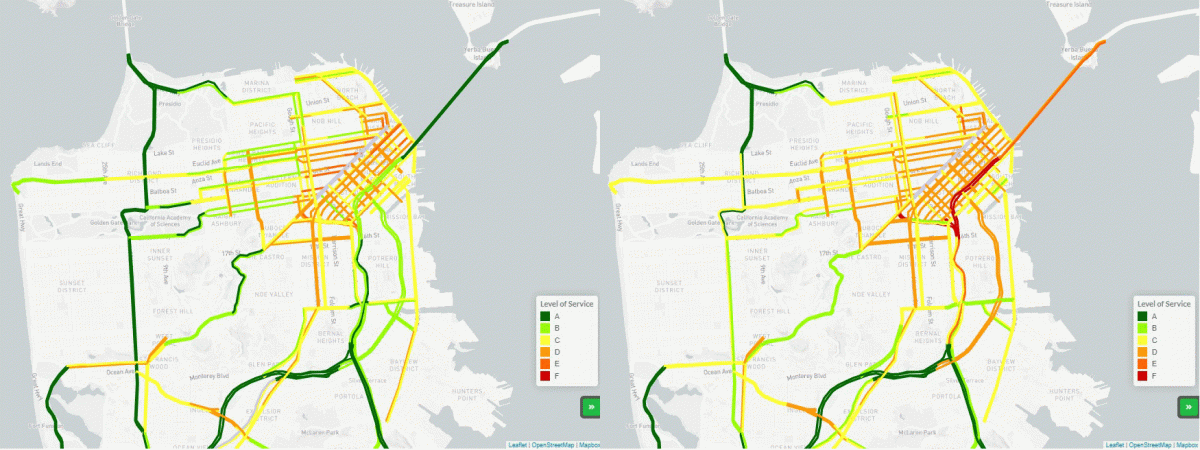
A map showing increased congestion between March 2020 and September 2020

Congestion has increased between March 2020 and September 2020. Find out more about congestion with the San Francisco Congestion Tracker

Before the pandemic, congestion in San Francisco was the worst it has ever been.  As the economy has been reopening, traffic congestion has begun to climb. Our partner agency, the San Francisco County Transportation Authority (SFCTA), has released a digital game where you can help manage this traffic congestion by pricing it. 

Curbing congestion 

As congestion returns, commutes get longer and severe and fatal collisions and climate emissions increase. Low-income communities and communities of color- with high use of public transit, and living in areas with high rates of traffic collisions and air pollution-bear the brunt of the burden of congestion’s impact.   

In 2019, the city started to investigate how reduce congestion and congestion’s unwanted and inequitable outcomes by using pricing . Congestion pricing is a tool that has been used successfully by cities around the world to reduce congestion. Like those cities, San Francisco could use congestion pricing to keep traffic moving, increase roadway safety, clean the air and advance equity. 

How should congestion pricing work in San Francisco? 

The city  wants your help to determine the best way to design congestion pricing by providing feedback about potential fees discounts, exemptions or incentives.  They are also asking about how you would invest revenue generated by congestion pricing. 

To share your thoughts you can:  

Play Unclog Fog City  
Play a digital game that lets you design your own congestion pricing program. 

Complete a survey via text message 
For English: Text TRAFFIC to 415-449-4214 
For Spanish: Text TRAFICO to 415-449-4214  
For Chinese: Text 交通 to 415-449-4214 
For Filipino: Text TRAPIK to 415-449-4214 

Share with your Friends 
Share these opportunities to get involved on Twitter, Facebook, and LinkedIn

To learn more about the effort visit the Downtown Congestion Pricing Study webpage and sign up to receive email updates. 


Published September 26, 2020 at 05:16AM
https://ift.tt/3kT0xBP

Comments

Popular posts from this blog

Celebrating the life and legacy of Harvey Milk

Celebrating the life and legacy of Harvey Milk By Sophia Scherr Today we celebrate and remember the life of San Francisco LGBTQ+ advocate and icon, Harvey Milk. One of our city’s most revered politicians, Milk's legacy as the first openly gay San Francisco supervisor and elected official in California helped in breaking down discriminatory barriers and usher LGBTQ+ politicians in government positions. Milk also advocated for equitable transportation, as he rode Muni exclusively since he did not own a car. He was a firm believer that affordable mobility was important in creating a thriving and livable city. Below is Harvey Milk with Curtis E. Green, General Manager of the Municipal Railway promoting Muni’s “Fast Pass”. Mr. Green was a barrier-breaking figure in his own right, by becoming the first African American appointed to Muni's top position from his beginnings with the Agency as a bus operator. With his 1974 appointment, Green also became the first African American to ...

Introducing My Shocks. 😉 Ciggerate Whatsapp Status (SAD BOYS)#short #shorts #cigarette

via https://youtu.be/RpDENmVEg7M

By The Numbers: The SFMTA’s COVID-19 Response

By The Numbers: The SFMTA’s COVID-19 Response By Erica Kato The COVID-19 pandemic has brought about unforeseen c hanges to San Francisco’s transportation network. And the impact of the crisis will continue to be felt city-wide long beyond the end of the public health emergency. On March 13, 2020, when it became clear that San Francisco needed immediate adjustments to the transportation system, Director of Transportation Jeff Tumlin launched SFMTA’s Department Operations Center (DOC) team. Since then, the DOC has served as a centralized hub to ensure that we are minimizing health risks to employees and the public as we keep transportation running, both by coordinating internally within the agency and by collaborating closely with our city, state, and federal partners to deploy resources and information in the most effective way possible. San Francisco's response to the COVID-19 pandemic included implementing temporary emergency transit lanes  Our COVID-19 response has chal...