
Valencia Street and Grant Street: The first two “Shared Spaces” Street Closures 

Valencia Street and Grant Street: The first two “Shared Spaces” Street Closures 
By Phillip Pierce

To expand public space for physically distanced outdoor dining, retail and mobility, the city’s Shared Spaces program will close parts of Valencia Street to traffic starting this week. This temporary repurposing of Valencia Street from Thursdays to Sundays is similar to another zone created on Grant Street in Chinatown on weekends. 

Valencia and Grant streets are the first two full street closures in the Shared Spaces program, initiated by Mayor Breed to support the economic and social recovery of neighborhood businesses. 
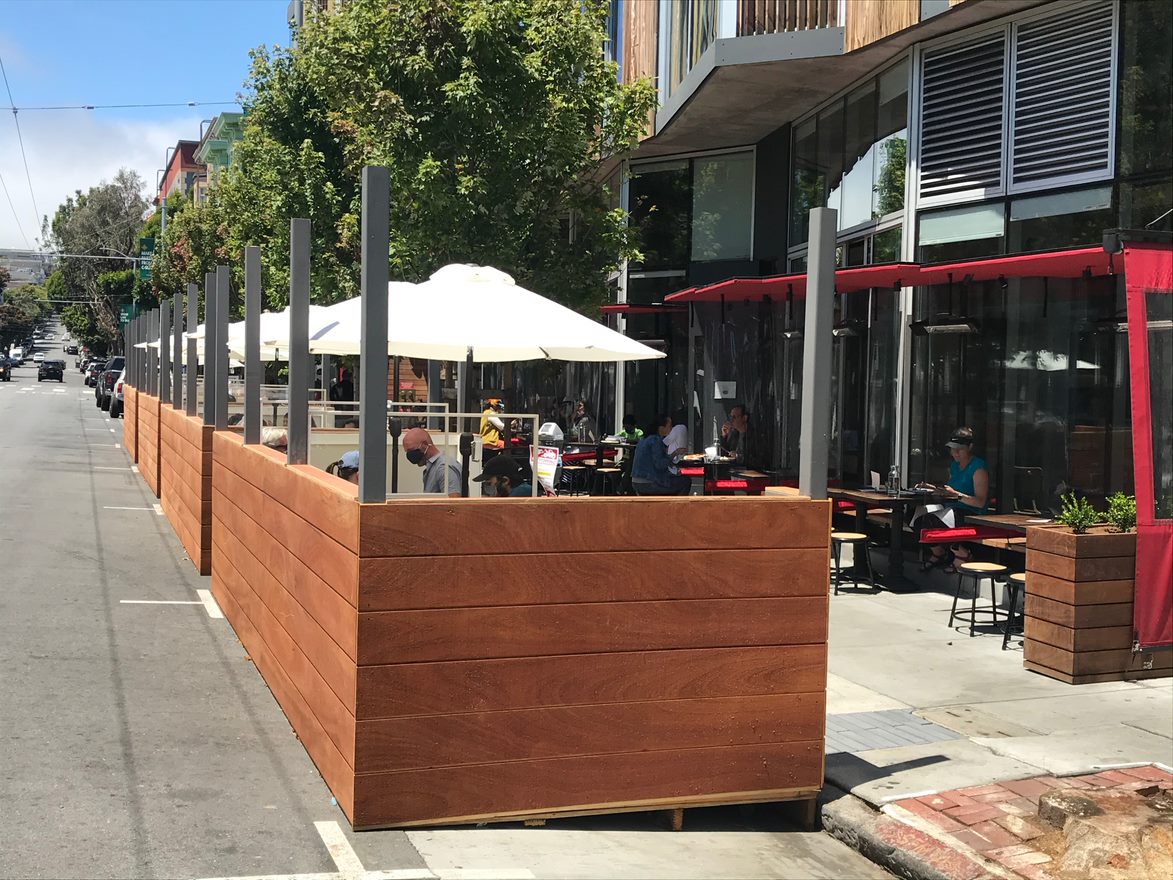
 A shared space in front of a Mano restaurant

a Mano restaurant in Hayes Valley using the area in front of their restaurant as a Shared Space.  

A multiagency city program of the Economic Recovery Task Force, the program allows merchants to use sidewalks, full or partial streets, and other nearby public spaces like parks and plazas for restaurant pick-up and other neighborhood retail activity, as allowed by San Francisco’s Public Health Order.  

Valencia Street Shared Space 

Beginning this week and continuing through the fall, each Thursday through Sunday from 4:00 p.m. to 10:00 p.m., the following blocks will be closed to traffic and open for people: 

  • Valencia between 16th and 17th streets  

  • Valencia between 17th and 18th streets (Local traffic and deliveries allowed)  

  • Valencia between 18th and 19th streets 

Local traffic for residents and deliveries will be tightly controlled by ambassadors on Valencia between 17th and 18th streets. All parking for this block will be converted into short-term loading zones for the same hours each week. These loading zones will support take-out food orders, passenger drop-off and pick-up and similar uses. Normal parking will not be allowed on the block during this time. People walking and biking may pass through the entire length of the Shared Space on Valencia from 16th to 19th streets anywhere on the street. 

Grant Street Shared Space 

As of last weekend and through the fall, parts of Grant and Commercial streets in Chinatown will be temporarily closed to traffic every Saturday and Sunday from 8:00 a.m. to 9:00 p.m. Parking along the following blocks is restricted during the operational time and through traffic is advised to use other routes. 

  • Grant between California and Washington streets 

  • Commercial between Kearny Street and Grant Avenue 

The first weekend was huge success and the community looks forward to the coming weekends. As a reminder, these spaces are not for block parties/gatherings and all rules related to physical distancing, face covering, and other public health requirements apply. 

Find Out How Your Business Can Apply for Shared Spaces

For more information on the program or to apply visit the Shared Spaces website. Each application is reviewed by a city committee with representatives from SF Planning, SFMTA, Public Works, the Fire Department and SFPD to ensure it does not interfere with emergency operations, meets accessibility requirements and has a solid operation plan. Business owners self-manage the Shared Spaces and must have plans for public safety and compliance with the Americans with Disabilities Act (ADA).  


Published July 24, 2020 at 04:48AM
https://ift.tt/2D1LYv7

Comments

Popular posts from this blog

Slow Streets Program to Help With Social Distancing

Slow Streets Program to Help With Social Distancing By With Muni service temporarily reduced during the COVID-19 health crisis, many San Francisco residents need to walk and take other modes of transportation to make essential trips. However, sometimes it is difficult to maintain 6’ of social distance on many sidewalks, park paths, and bikeways. This can be especially true when passing lines outside grocery stores and other essential services. Because of this, many pedestrians are choosing to walk in the street, exposing themselves to swiftly moving vehicle traffic. The SFMTA is implementing a new program, Slow Streets, to close some streets to through traffic and allow roadways to be used more as a shared space for foot and bicycle traffic. Throughout the city, corridors have been identified for Phase 1 Slow Streets. Beginning this week, some of these streets will be closed to through vehicle traffic to prioritize walking/biking and to provide more space for social distancing duri...

Weight Loss Success Stories: 6 People Share How They Shed Pounds with a High-Protein Diet

Weight Loss Success Stories: 6 People Share How They Shed Pounds with a High-Protein Diet Sarah:  Sarah, a 32-year-old mother of two, struggled with her weight after having her second child. She decided to try a high-protein diet and was able to lose 30 pounds in just three months. She replaced her breakfast with a protein shake, ate a salad with grilled chicken for lunch, and had fish or chicken with vegetables for dinner. Mike:  Mike, a 45-year-old man, had been overweight his entire life. He tried various diets, but none of them worked for him. He decided to give a high-protein diet a try and was able to lose 50 pounds in six months. He ate eggs, chicken, fish, and lean meats for most of his meals and limited his intake of carbohydrates and sugary foods. Emily:  Emily, a 28-year-old woman, had been struggling with her weight since her teenage years. She tried many diets and weight loss programs, but nothing seemed to work for her. She decided to try a high-p...

By The Numbers: The SFMTA’s COVID-19 Response

By The Numbers: The SFMTA’s COVID-19 Response By Erica Kato The COVID-19 pandemic has brought about unforeseen c hanges to San Francisco’s transportation network. And the impact of the crisis will continue to be felt city-wide long beyond the end of the public health emergency. On March 13, 2020, when it became clear that San Francisco needed immediate adjustments to the transportation system, Director of Transportation Jeff Tumlin launched SFMTA’s Department Operations Center (DOC) team. Since then, the DOC has served as a centralized hub to ensure that we are minimizing health risks to employees and the public as we keep transportation running, both by coordinating internally within the agency and by collaborating closely with our city, state, and federal partners to deploy resources and information in the most effective way possible. San Francisco's response to the COVID-19 pandemic included implementing temporary emergency transit lanes  Our COVID-19 response has chal...