
Improving Forest Hill Park and Realizing City Sustainability Goals

Improving Forest Hill Park and Realizing City Sustainability Goals
By Jay Lu

Thanks to agency partners, community support and Supervisor Yee, the Forest Hill Irrigation Improvement Project was completed in late June. This project aims to conserve water, increase biodiversity, and improve the park conditions at the Forest Hill transit station.
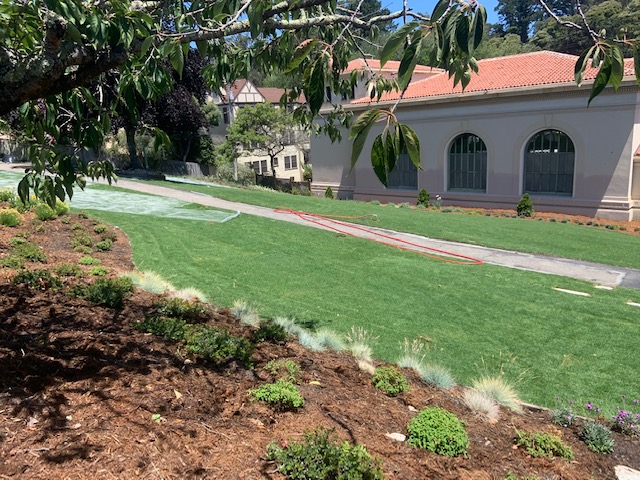
Forrest Hill Station with new sod and irrigation system

Funded by SFMTA and the San Francisco Public Utility Commission’s Large Landscape Grant Program, the project has upgraded the station area’s 40-year-old irrigation system and replaced the existing sod with a new variety that requires less water. The project also introduced drought tolerant and native plants selected with input from the community which will surround the historic Forest Hill station that opened to transit service in 1918.

In addition, a Nature Exploration Area was constructed as part of the project with funding and design by SF Rec & Park. The five-month construction started in February 2020. To give the new sod ample time to establish, the park will remain closed until mid-August.

By saving up to 442,494 gallons of water per year, the project, a multiple city agency collaboration by the SFMTA, SFPUC, Public Works and Rec & Park, supports citywide water conservation, biodiversity and sustainability goals at the Forest Hill Station.

The SFMTA wants to take this opportunity to thank our community partners, Supervisor Yee and our sister agencies for their support in shaping the design and moving the innovative project forward.

For more information, visit SFMTA.com/Foresthillirrigation


Published July 22, 2020 at 01:03AM
https://ift.tt/2WGO6zp

Comments

Popular posts from this blog

Celebrating the life and legacy of Harvey Milk

Celebrating the life and legacy of Harvey Milk By Sophia Scherr Today we celebrate and remember the life of San Francisco LGBTQ+ advocate and icon, Harvey Milk. One of our city’s most revered politicians, Milk's legacy as the first openly gay San Francisco supervisor and elected official in California helped in breaking down discriminatory barriers and usher LGBTQ+ politicians in government positions. Milk also advocated for equitable transportation, as he rode Muni exclusively since he did not own a car. He was a firm believer that affordable mobility was important in creating a thriving and livable city. Below is Harvey Milk with Curtis E. Green, General Manager of the Municipal Railway promoting Muni’s “Fast Pass”. Mr. Green was a barrier-breaking figure in his own right, by becoming the first African American appointed to Muni's top position from his beginnings with the Agency as a bus operator. With his 1974 appointment, Green also became the first African American to ...

By The Numbers: The SFMTA’s COVID-19 Response

By The Numbers: The SFMTA’s COVID-19 Response By Erica Kato The COVID-19 pandemic has brought about unforeseen c hanges to San Francisco’s transportation network. And the impact of the crisis will continue to be felt city-wide long beyond the end of the public health emergency. On March 13, 2020, when it became clear that San Francisco needed immediate adjustments to the transportation system, Director of Transportation Jeff Tumlin launched SFMTA’s Department Operations Center (DOC) team. Since then, the DOC has served as a centralized hub to ensure that we are minimizing health risks to employees and the public as we keep transportation running, both by coordinating internally within the agency and by collaborating closely with our city, state, and federal partners to deploy resources and information in the most effective way possible. San Francisco's response to the COVID-19 pandemic included implementing temporary emergency transit lanes  Our COVID-19 response has chal...

Slow Streets Program to Help With Social Distancing

Slow Streets Program to Help With Social Distancing By With Muni service temporarily reduced during the COVID-19 health crisis, many San Francisco residents need to walk and take other modes of transportation to make essential trips. However, sometimes it is difficult to maintain 6’ of social distance on many sidewalks, park paths, and bikeways. This can be especially true when passing lines outside grocery stores and other essential services. Because of this, many pedestrians are choosing to walk in the street, exposing themselves to swiftly moving vehicle traffic. The SFMTA is implementing a new program, Slow Streets, to close some streets to through traffic and allow roadways to be used more as a shared space for foot and bicycle traffic. Throughout the city, corridors have been identified for Phase 1 Slow Streets. Beginning this week, some of these streets will be closed to through vehicle traffic to prioritize walking/biking and to provide more space for social distancing duri...