
As the city gradually reopens, mechanical street sweeping enforcement is set to resume

As the city gradually reopens, mechanical street sweeping enforcement is set to resume
By

Mayor London N. Breed and the San Francisco Municipal Transportation Agency (SFMTA) today announced that the City will resume enforcement for parking violations related to street sweeping beginning on Monday, June 15.
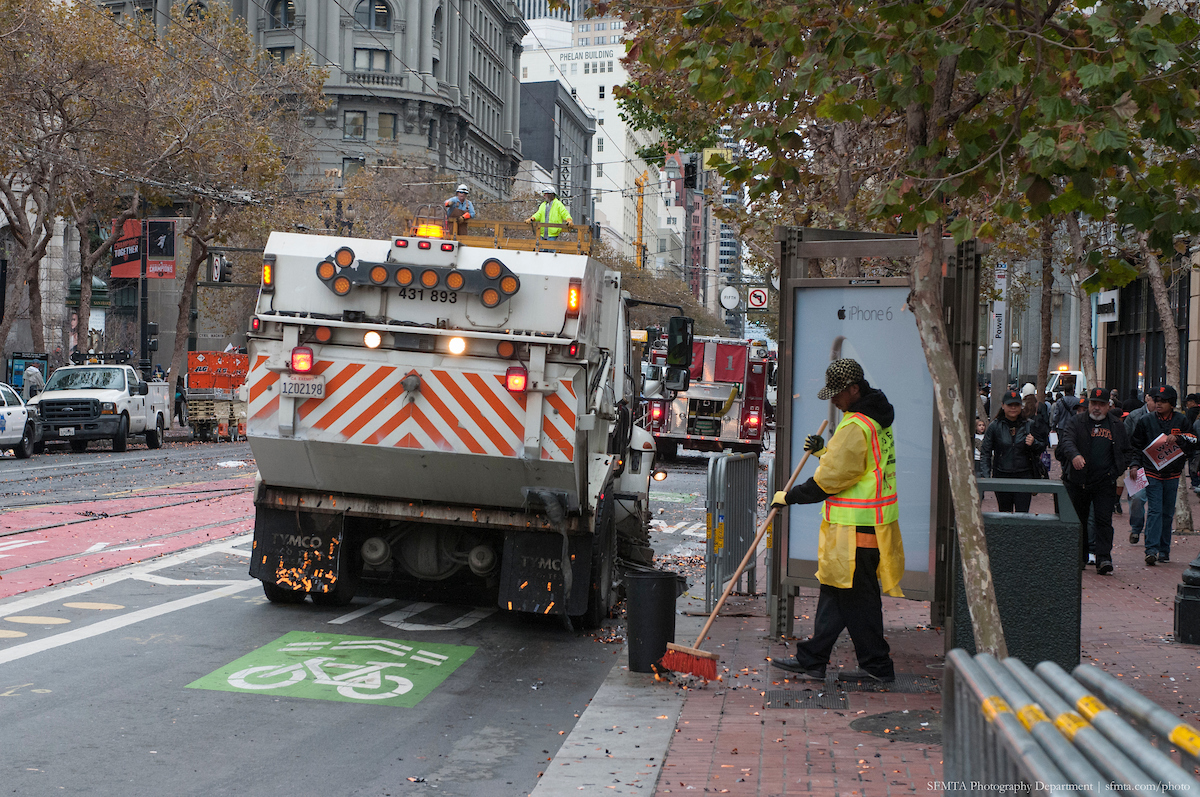
Street sweeping taking place along Market Street

Mayor Breed had announced on March 17 that SFMTA would not ticket for street sweeping following the Stay Home Order for COVID-19 in order to allow people to stay home without worrying about receiving a parking ticket. While the City had still encouraged people to move their vehicles if they could, street sweeping crews from San Francisco Public Works continue to see a large number of vehicles failing to do so, as many as 18,000 per day. Resuming enforcement for mechanical street sweeping is necessary to ensure that streets remain clean as the City begins to allow more businesses and activities to resume.

“At the beginning of the Stay Home Order we wanted to ensure that people who were sick were able to isolate themselves without needing to leave to move their vehicles,” said Mayor Breed. “Now as we’re reopening, we’ve reached the point where we must resume parking enforcement so that we can clean our streets. We’ll of course continue waiving tickets for people who face issues related to COVID-19.”

“Our agency’s main objective during our COVID-19 response was to promote safety and minimize risk to San Franciscans,” said Jeffrey Tumlin, SFMTA Director of Transportation. “As more businesses open up and more residents return to work, now is the right time to ensure our streets are clean and ready to support economic activity.”

“We certainly understand the needed pause on street cleaning enforcement during the early months of shelter in place, but there have been consequences. Our mechanical sweeping crews have not been able to do as thorough a job cleaning, resulting in more litter and leaves on the streets,” said Acting Public Works Director Alaric Degrafinried. “As the City is slowly starting to reopen, we once again can provide the service San Franciscans expect and deserve.”


Published June 06, 2020 at 02:48AM
https://ift.tt/30jYf7s

Comments

Popular posts from this blog

Celebrating the life and legacy of Harvey Milk

Celebrating the life and legacy of Harvey Milk By Sophia Scherr Today we celebrate and remember the life of San Francisco LGBTQ+ advocate and icon, Harvey Milk. One of our city’s most revered politicians, Milk's legacy as the first openly gay San Francisco supervisor and elected official in California helped in breaking down discriminatory barriers and usher LGBTQ+ politicians in government positions. Milk also advocated for equitable transportation, as he rode Muni exclusively since he did not own a car. He was a firm believer that affordable mobility was important in creating a thriving and livable city. Below is Harvey Milk with Curtis E. Green, General Manager of the Municipal Railway promoting Muni’s “Fast Pass”. Mr. Green was a barrier-breaking figure in his own right, by becoming the first African American appointed to Muni's top position from his beginnings with the Agency as a bus operator. With his 1974 appointment, Green also became the first African American to ...

By The Numbers: The SFMTA’s COVID-19 Response

By The Numbers: The SFMTA’s COVID-19 Response By Erica Kato The COVID-19 pandemic has brought about unforeseen c hanges to San Francisco’s transportation network. And the impact of the crisis will continue to be felt city-wide long beyond the end of the public health emergency. On March 13, 2020, when it became clear that San Francisco needed immediate adjustments to the transportation system, Director of Transportation Jeff Tumlin launched SFMTA’s Department Operations Center (DOC) team. Since then, the DOC has served as a centralized hub to ensure that we are minimizing health risks to employees and the public as we keep transportation running, both by coordinating internally within the agency and by collaborating closely with our city, state, and federal partners to deploy resources and information in the most effective way possible. San Francisco's response to the COVID-19 pandemic included implementing temporary emergency transit lanes  Our COVID-19 response has chal...

Slow Streets Program to Help With Social Distancing

Slow Streets Program to Help With Social Distancing By With Muni service temporarily reduced during the COVID-19 health crisis, many San Francisco residents need to walk and take other modes of transportation to make essential trips. However, sometimes it is difficult to maintain 6’ of social distance on many sidewalks, park paths, and bikeways. This can be especially true when passing lines outside grocery stores and other essential services. Because of this, many pedestrians are choosing to walk in the street, exposing themselves to swiftly moving vehicle traffic. The SFMTA is implementing a new program, Slow Streets, to close some streets to through traffic and allow roadways to be used more as a shared space for foot and bicycle traffic. Throughout the city, corridors have been identified for Phase 1 Slow Streets. Beginning this week, some of these streets will be closed to through vehicle traffic to prioritize walking/biking and to provide more space for social distancing duri...