
HeadsUp: Nightly Subway Maintenance Starting January 26

HeadsUp: Nightly Subway Maintenance Starting January 26
By Benjamin Barnett

The subway will be closing early each night at 9:30 p.m. starting January 26 and continuing for approximately one week for extended maintenance hours. Bus substitution service will connect to all stops.

On most nights, our teams have about two hours to get work done between evening and morning service. In order to complete critical maintenance tasks that cannot be completed during normal windows, we are planning this week of early subway closures, so crews have more hours each night to do vital work. This is our ongoing effort to maintain the subway infrastructure to ensure safety and reliability. The last early subway closures for maintenance took place in August 2019. 

What Are We Doing?

  • Track Maintenance. Installing new track hardware in a pilot segment to evaluate new technology.
  • Signal Maintenance. Perform cable tests and inspections to identify problems and future upgrades.
  • Overhead Lines. Replace worn overhead wire; Adjust system supports and tension to deliver better performance of pantographs and improve overhead wire life.
  • Custodial Services. Deep cleaning each station.
  • Station Maintenance. Address overdue or restricted access maintenance and preventative maintenance priorities.

When the subway closes, buses will run above ground to connect all stops through the normal end of train service. Owl service will remain unchanged. Trains will start regular morning service each day.

Transit Service Plan – 9:30 p.m. to 1 a.m.

  • Shuttle buses will serve all Muni Metro stops between Embarcadero & Brannan and St. Francis Circle
  • K – Train service between Balboa Park and St. Francis Circle
  • L – Train service between SF Zoo and West Portal
  • M – Train service between Balboa Park and West Portal
  • N – Train service between Ocean Beach and Church & Duboce
  • J – Train service between Balboa Park and Church & Duboce
  • T – Train service between Sunnydale and Embarcadero & Brannan

Inbound N Judah and outbound J Church trains will use the accessible stop entering the Duboce Portal to serve customers needing the ramp.

Plan extra travel time when riding Muni during subway closure. Regular bus fares will apply on bus shuttles and valid transfers will be accepted.
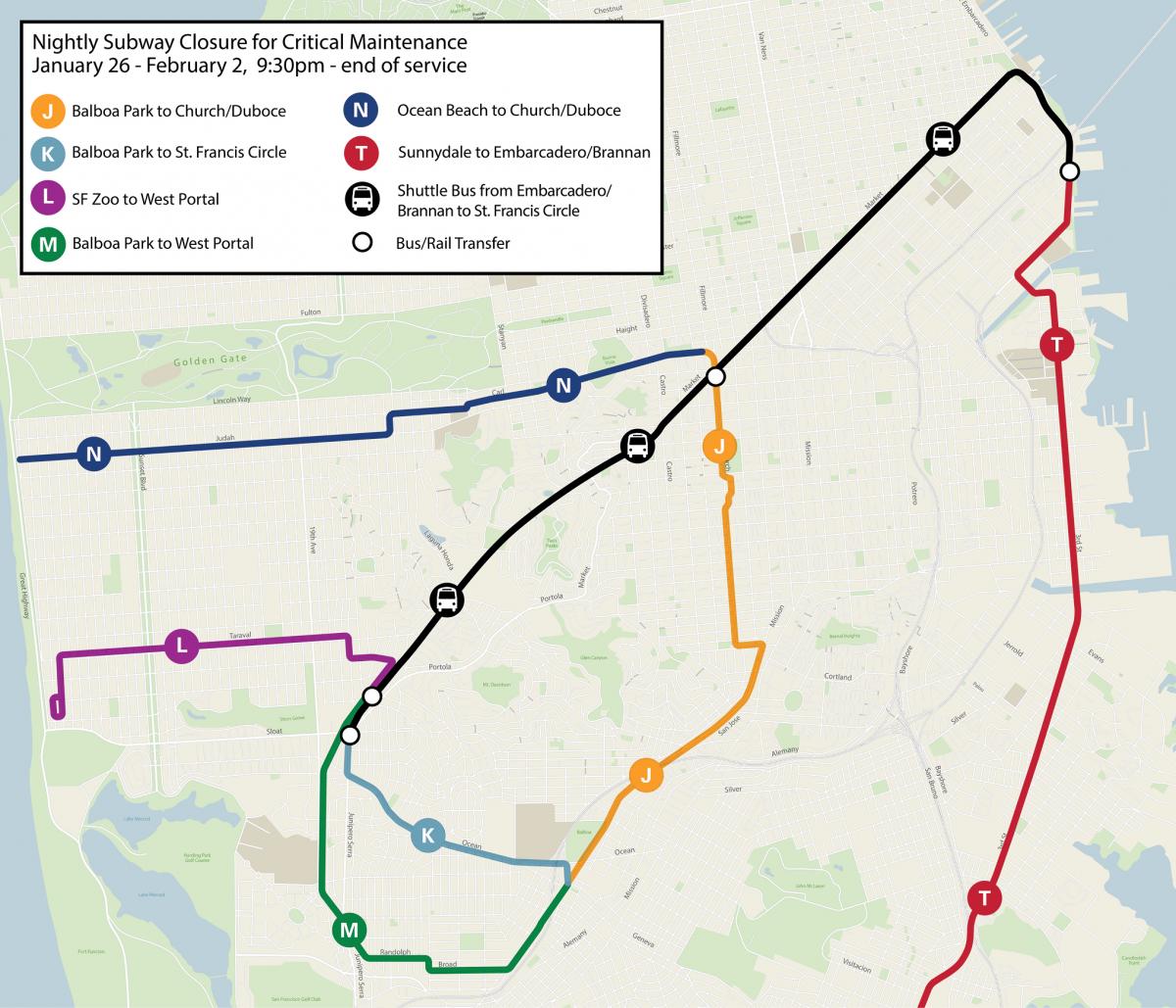
Early Subway Closure Map

What Did We Complete In August?

Track Maintenace

  • Replaced four worn switch points.
  • Removed and replaced two sections of corroded rail. 
  • Replaced two curved switch points at Duboce.

Signal Maintenace

  • Replaced batteries for the following relay rooms: Church, Civic Center, Castro, Embarcadero, Forest Hill and Powell Station.
  • Provided support to Track Maintenance to make final adjustments to the switches. 
  • Performed an end to end inspection of the ATCS (Automatic Train Control System) from West Portal to Castro Station.

Overhead Lines

  • Replaced a total of 4700 feet of overhead contact wire and support hardware at various locations.
  • Eliminated 30 wire splices
  • Removed, replaced and aligned five Section Breaks


Published January 22, 2020 at 11:25PM
https://ift.tt/2NQFbGY

Comments

Popular posts from this blog

Slow Streets Program to Help With Social Distancing

Slow Streets Program to Help With Social Distancing By With Muni service temporarily reduced during the COVID-19 health crisis, many San Francisco residents need to walk and take other modes of transportation to make essential trips. However, sometimes it is difficult to maintain 6’ of social distance on many sidewalks, park paths, and bikeways. This can be especially true when passing lines outside grocery stores and other essential services. Because of this, many pedestrians are choosing to walk in the street, exposing themselves to swiftly moving vehicle traffic. The SFMTA is implementing a new program, Slow Streets, to close some streets to through traffic and allow roadways to be used more as a shared space for foot and bicycle traffic. Throughout the city, corridors have been identified for Phase 1 Slow Streets. Beginning this week, some of these streets will be closed to through vehicle traffic to prioritize walking/biking and to provide more space for social distancing duri...

Weight Loss Success Stories: 6 People Share How They Shed Pounds with a High-Protein Diet

Weight Loss Success Stories: 6 People Share How They Shed Pounds with a High-Protein Diet Sarah:  Sarah, a 32-year-old mother of two, struggled with her weight after having her second child. She decided to try a high-protein diet and was able to lose 30 pounds in just three months. She replaced her breakfast with a protein shake, ate a salad with grilled chicken for lunch, and had fish or chicken with vegetables for dinner. Mike:  Mike, a 45-year-old man, had been overweight his entire life. He tried various diets, but none of them worked for him. He decided to give a high-protein diet a try and was able to lose 50 pounds in six months. He ate eggs, chicken, fish, and lean meats for most of his meals and limited his intake of carbohydrates and sugary foods. Emily:  Emily, a 28-year-old woman, had been struggling with her weight since her teenage years. She tried many diets and weight loss programs, but nothing seemed to work for her. She decided to try a high-p...

By The Numbers: The SFMTA’s COVID-19 Response

By The Numbers: The SFMTA’s COVID-19 Response By Erica Kato The COVID-19 pandemic has brought about unforeseen c hanges to San Francisco’s transportation network. And the impact of the crisis will continue to be felt city-wide long beyond the end of the public health emergency. On March 13, 2020, when it became clear that San Francisco needed immediate adjustments to the transportation system, Director of Transportation Jeff Tumlin launched SFMTA’s Department Operations Center (DOC) team. Since then, the DOC has served as a centralized hub to ensure that we are minimizing health risks to employees and the public as we keep transportation running, both by coordinating internally within the agency and by collaborating closely with our city, state, and federal partners to deploy resources and information in the most effective way possible. San Francisco's response to the COVID-19 pandemic included implementing temporary emergency transit lanes  Our COVID-19 response has chal...