
Car-Free Market Street starts January 29

Car-Free Market Street starts January 29
By Phillip Pierce

Better Market Street is set to transform our city’s busiest street for people walking, biking and riding transit over the next few years, but we don’t need to wait for construction to make it safer and improve Muni.

Starting on January 29th through our Quick-build program, Market Street will become car-free eastbound from 10th to Main and westbound from Steuart to Van Ness. In addition to restricting private vehicles, the quick-build includes extending Muni only lanes, new loading zones and much-needed intersection safety improvements.
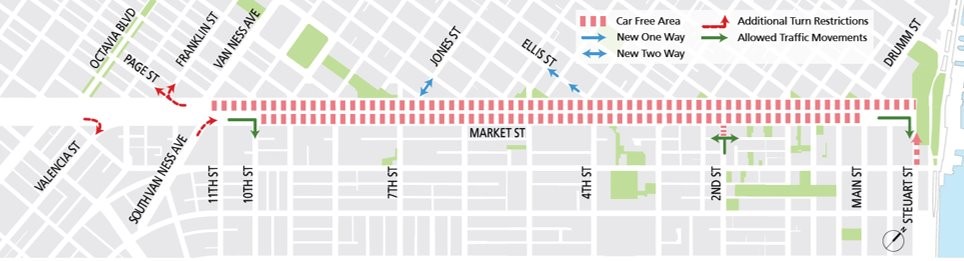
Map of changes coming late January 2020. Figure 4: Rendering including Better Market Street’s sidewalk level bike lane, new trees and improved streetscape elements.
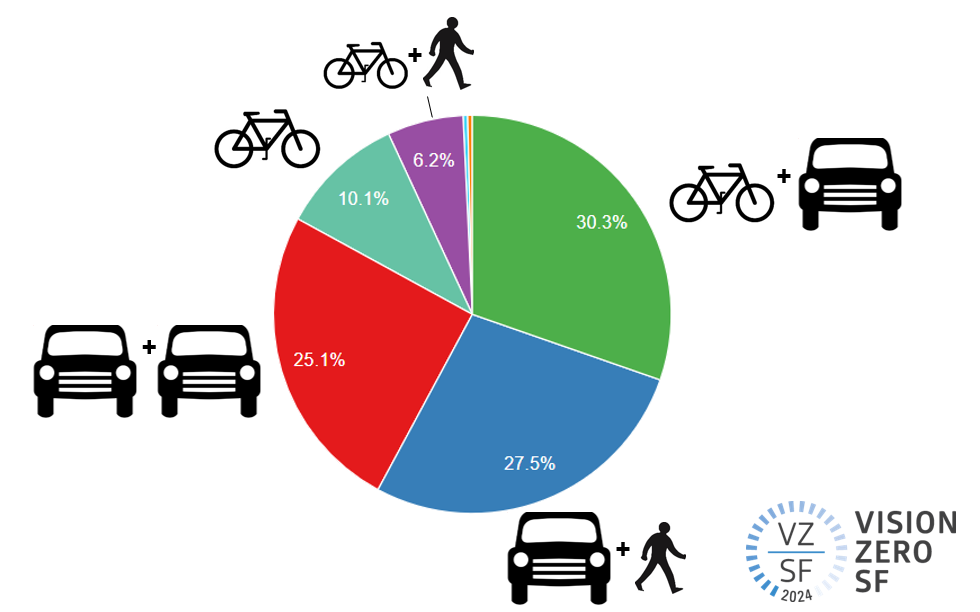
Figure 1: Map of changes coming late January 2020. Figure 4: Rendering including Better Market Street’s sidewalk level bike lane, new trees and improved streetscape elements.
 
These changes can’t come soon enough because unfortunately, Market Street is home to half of the top 10 intersections for pedestrian and bicycle collisions. In fact, each year since 2014 the area-averaged over 100 injury collisions per year -- 75 percent of them involving people walking or biking. By reducing conflicts with proven safety measures like turn restrictions, painted safety zones and safe-hit posts, we can get closer to our city’s Vision Zero goal of eliminating traffic deaths and serious injuries on San Francisco roads.
Pie chart showing share of injury collisions by travel mode on Market Street since 2014
Figure 2: Share of injury collisions by travel mode on Market Street since 2014

In addition to safety benefits, going car-free on Market will prioritize transit on a street that sees upwards of 200 buses per hour during peak times. With bus lines branching throughout San Francisco, boosting Muni's reliability on Market street will positively affect the whole city!
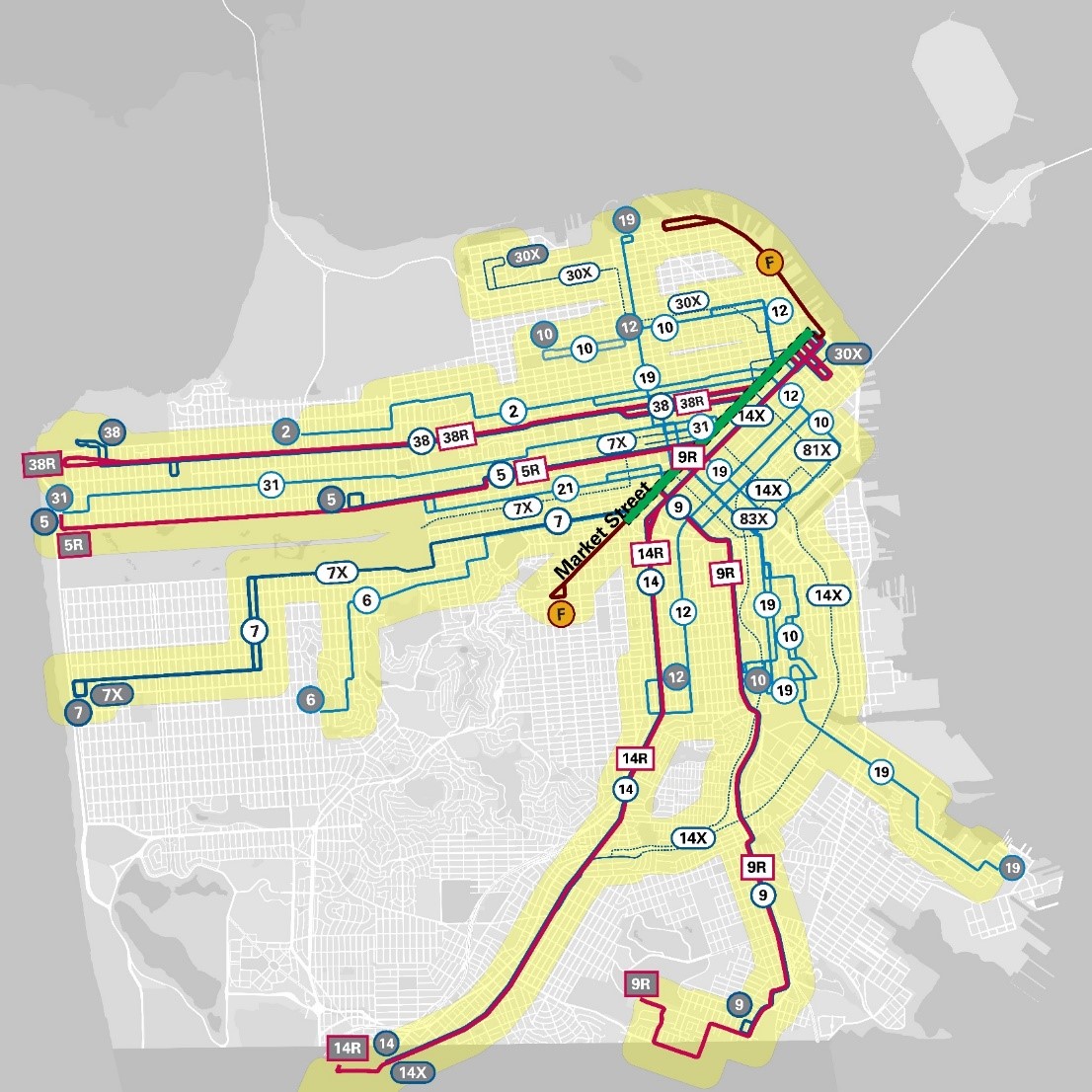
Map showing all surface Muni routes that use Market Street for a portion of their route. Improving the functionality of Market will help enhance transit to many parts of the City.
Figure 3: Map showing all surface Muni routes that use Market Street for a portion of their route. Improving the functionality of Market will help enhance transit to many parts of the City.

Quick-build Elements starting in January: Full Details

While Market Street officially becomes car-free on January 29th, other changes listed below are set to be implemented over the first few months of 2020.

Vehicle Changes

  • No private vehicles allowed on Market Street eastbound from 10th to Main and westbound from Steuart to Van Ness -- including app-based ride hail companies like Uber/Lyft.  
  • All traffic can continue to cross Market street at intersections.
  • Vehicles with commercial plates, taxis, emergency vehicles and paratransit will still be able to use Market Street. 
  • Vehicle direction changes for sections of Ellis, Jones, Second and Steuart streets to improve safety and vehicle circulation (see map in Figure 1 for details).
  • Right turns onto Valencia from eastbound Market Street will no longer be allowed, Page Street will become a bike-only connection to and from Market Street.

Transit Enhancements

  • Extending existing transit-only lane east from Third to Main Street, the segment of Market with the most transit service, and making it Muni-only (taxis and non-Muni buses will no longer be allowed in center lane)
  • Converting the existing red transit-only lane to Muni-only between 9th and Third streets
  • Converting the existing red transit-only lane to Muni & taxi only between 12th and 9th streets
  • Buses in the curb lane will benefit from the car-free restrictions as well

Loading Changes

  • 100 new cross-street passenger and commercial loading zones to accommodate safe loading
  • Peak hour loading restrictions on Market Street to reduce conflicts between people on bicycles, transit and commercial vehicles:
    • No southside loading in the eastbound direction (towards the Ferry Building) on weekdays 6:00 am to 9:30 am.
    • No northside loading in the westbound direction (towards Twin Peaks) on weekdays between 3:00 pm and 7:30 pm. 

Additional Safety Improvements

  • Installing painted safety zones at eight intersections to make crossing the street safer and shorter
  • New bicycle intersection improvements at Eighth, Page, Battery, and Valencia streets.

Project Information

Quick-build is just the first step in implementing Better Market Street, the City’s multi-agency project to transform 2.2 miles of Market Street from Octavia Boulevard to Steuart Street. The project’s goal is to enhance safety and accessibility, improve transit performance, replace aging infrastructure, and revitalize the corridor’s streetscape.

Construction on the full project will be managed by Public Works and is expected to start in late 2020 or early 2021. For project details, please visit bettermarketstreetSF.org
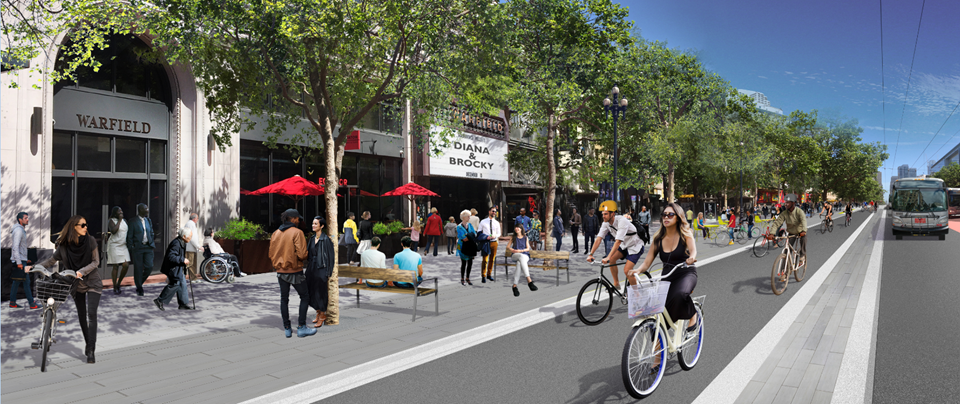
Rendering including Better Market Street’s sidewalk level bike lane, new trees and improved streetscape elements.
Figure 4: Rendering including Better Market Street’s sidewalk level bike lane, new trees and improved streetscape elements.


Published December 31, 2019 at 11:54PM
https://ift.tt/2QaLtD1

Comments

Popular posts from this blog

Celebrating the life and legacy of Harvey Milk

Celebrating the life and legacy of Harvey Milk By Sophia Scherr Today we celebrate and remember the life of San Francisco LGBTQ+ advocate and icon, Harvey Milk. One of our city’s most revered politicians, Milk's legacy as the first openly gay San Francisco supervisor and elected official in California helped in breaking down discriminatory barriers and usher LGBTQ+ politicians in government positions. Milk also advocated for equitable transportation, as he rode Muni exclusively since he did not own a car. He was a firm believer that affordable mobility was important in creating a thriving and livable city. Below is Harvey Milk with Curtis E. Green, General Manager of the Municipal Railway promoting Muni’s “Fast Pass”. Mr. Green was a barrier-breaking figure in his own right, by becoming the first African American appointed to Muni's top position from his beginnings with the Agency as a bus operator. With his 1974 appointment, Green also became the first African American to ...

By The Numbers: The SFMTA’s COVID-19 Response

By The Numbers: The SFMTA’s COVID-19 Response By Erica Kato The COVID-19 pandemic has brought about unforeseen c hanges to San Francisco’s transportation network. And the impact of the crisis will continue to be felt city-wide long beyond the end of the public health emergency. On March 13, 2020, when it became clear that San Francisco needed immediate adjustments to the transportation system, Director of Transportation Jeff Tumlin launched SFMTA’s Department Operations Center (DOC) team. Since then, the DOC has served as a centralized hub to ensure that we are minimizing health risks to employees and the public as we keep transportation running, both by coordinating internally within the agency and by collaborating closely with our city, state, and federal partners to deploy resources and information in the most effective way possible. San Francisco's response to the COVID-19 pandemic included implementing temporary emergency transit lanes  Our COVID-19 response has chal...

Slow Streets Program to Help With Social Distancing

Slow Streets Program to Help With Social Distancing By With Muni service temporarily reduced during the COVID-19 health crisis, many San Francisco residents need to walk and take other modes of transportation to make essential trips. However, sometimes it is difficult to maintain 6’ of social distance on many sidewalks, park paths, and bikeways. This can be especially true when passing lines outside grocery stores and other essential services. Because of this, many pedestrians are choosing to walk in the street, exposing themselves to swiftly moving vehicle traffic. The SFMTA is implementing a new program, Slow Streets, to close some streets to through traffic and allow roadways to be used more as a shared space for foot and bicycle traffic. Throughout the city, corridors have been identified for Phase 1 Slow Streets. Beginning this week, some of these streets will be closed to through vehicle traffic to prioritize walking/biking and to provide more space for social distancing duri...